Many travelers waste hours hunting for SIM cards at foreign airports or paying shocking roaming bills, yet a single QR code can unlock global connectivity before you even board your flight. eSIMs are digital SIMs activated via QR code that connect automatically to local partner networks the moment you land. This guide walks you through everything you need to know: how eSIMs work, which providers offer the best global coverage, what pitfalls to avoid, and how to squeeze maximum performance out of your connection no matter where your itinerary takes you.
Key Takeaways
Point
Details
eSIM streamlines global travel
Activating an eSIM before departure saves time and eliminates the hassle of hunting for local SIM cards at every destination.
Compare providers for best value
Airalo, Holafly, Saily, Nomad, and Ubigi offer varying coverage and pricing; choose based on your travel route and data needs.
Avoid common technical pitfalls
Check carrier lock status, manage eSIM profiles, and always activate with WiFi to dodge the most frequent issues.
Dual-SIM optimizes flexibility
Using both physical SIM and eSIM allows you to keep home services while enjoying affordable data worldwide.
Around Travel enhances your journey
Linking connectivity with transportation and local services makes every trip smoother, safer, and more enjoyable.
What is an eSIM and how does it work for global travelers?
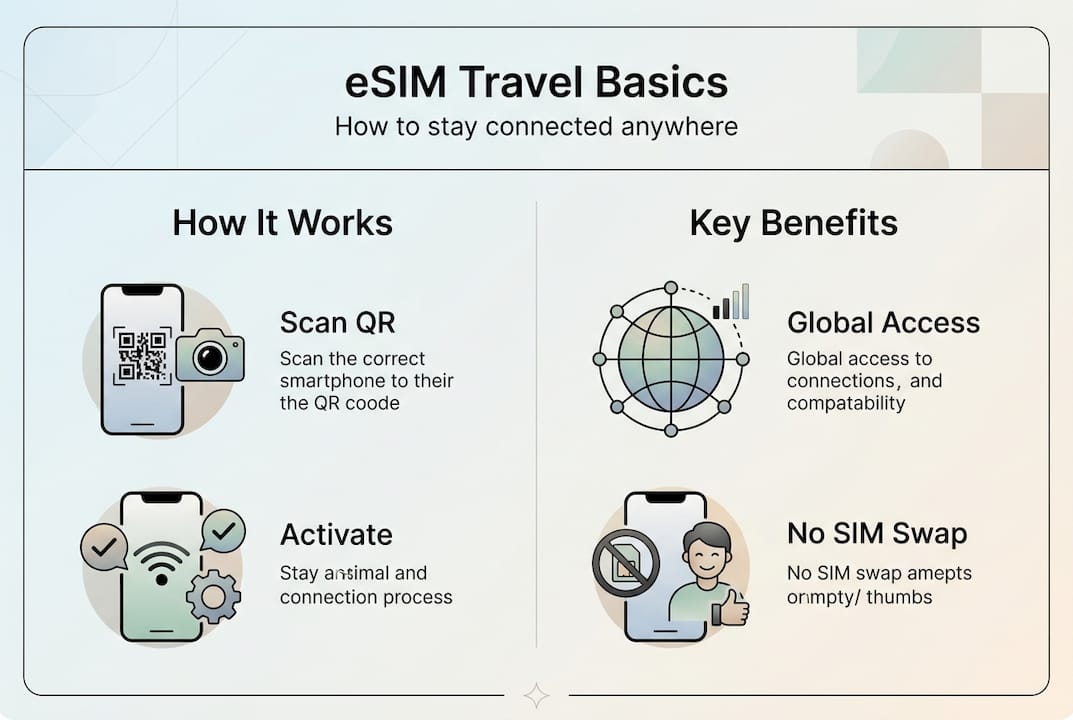
An eSIM, short for embedded SIM, is a programmable chip built directly into your phone. Unlike a physical SIM card you pop in and out, an eSIM stores multiple carrier profiles digitally. You download a plan, scan a QR code over WiFi, and your phone connects to a local network, often before you clear customs.
Here is what makes eSIM genuinely useful for international travel:
No physical swaps. You never fumble with a SIM ejector tool or risk losing a tiny card in a foreign hotel room.
Instant activation. Most plans activate in under five minutes via a QR code or a provider app.
Automatic network switching. Your device selects the strongest available partner network in each country without manual input.
Multiple profiles. You can store several regional plans on one device and switch between them as your route changes.
Safer for your device. Keeping your SIM tray closed means one less entry point for dust, moisture, and damage.
“eSIMs represent a fundamental shift in how travelers manage connectivity. The ability to switch carriers without touching hardware is not just convenient, it is a genuine safety net when plans change mid-trip.”
For travelers who also need to sort out entry requirements, pairing your eSIM setup with solid pre-trip research, including checking global visa guides, ensures you handle both connectivity and documentation before departure. The combination of digital SIM and digital visa processing reflects how modern travel logistics are converging into a fully paperless experience.
Major eSIM providers and global coverage comparison
Not all eSIM providers are equal. Coverage maps, data speeds, pricing structures, and app reliability vary significantly. Choosing the wrong provider for your itinerary can mean throttled speeds in Southeast Asia or dead zones across rural Europe. Here is how the top five stack up in 2026.
Provider
Countries covered
Unlimited plans
Avg. cost per GB
App rating
Airalo
200+
No
~$4.50
4.6/5
Holafly
170+
Yes
Flat rate
4.4/5
Saily
150+
Yes
~$3.80
4.5/5
Nomad
160+
No
~$5.00
4.3/5
Ubigi
190+
No
~$4.00
4.2/5
Top providers cover 200+ countries, but pricing, unlimited data availability, and network speed vary considerably between them. Airalo wins on raw country count and is ideal for multi-continent itineraries. Holafly and Saily suit heavy streamers and remote workers who need unlimited data without tracking gigabytes. Nomad and Ubigi appeal to travelers who want pay-as-you-go flexibility with solid network partnerships.
Key factors to weigh when choosing your provider:
Direct carrier partnerships. Providers that partner directly with Tier 1 carriers (not resellers) deliver faster, more consistent speeds.
Data throttling policies. Some unlimited plans drop to 2G after a daily threshold. Read the fine print.
Regional vs. global plans. A regional plan for Europe often costs less than a global plan if your trip stays within one continent.
Customer support. Live chat support matters when you land at midnight and your plan fails to activate.
Pro Tip: Before committing to a provider, cross-reference their coverage map with your specific destinations, not just the country count. A provider claiming 200 countries may have weak coverage in the rural areas you plan to visit.
Pairing your eSIM research with the right travel planning apps helps you manage every layer of your trip from one place, keeping connectivity, bookings, and itineraries organized without juggling a dozen separate tools.
Common pitfalls and troubleshooting: What every traveler should know
eSIMs are not foolproof. Real-world edge cases trip up even experienced travelers. Knowing what can go wrong, and how to fix it fast, saves you from being stranded without data in an unfamiliar city.
Carrier-locked devices. If your phone is locked to a home carrier, it will reject eSIM profiles from other providers. Contact your carrier before travel to request an unlock, which is legally required in many countries after your contract period ends.
Activation requires stable WiFi. You cannot activate an eSIM on cellular data alone. Always download and activate your plan before leaving a reliable WiFi connection, ideally at home or at the airport lounge.
Border and rural network gaps. Handover between partner networks at borders can cause brief outages. This is normal. Your phone will reconnect within minutes, but avoid relying on real-time navigation during border crossings.
Profile storage limits. Most phones store between 5 and 20 eSIM profiles, but only one or two can be active simultaneously. Delete old profiles regularly to avoid hitting the cap.
Transferring eSIM to a new phone. Unlike a physical SIM, you cannot simply move an eSIM to a new device. Most providers require you to delete the old profile and issue a new QR code, which can take 24 hours.
Network congestion and deprioritization. On unlimited plans, your data may be deprioritized during peak hours in crowded areas like festivals or transit hubs. Switch to a limited but high-priority plan if speed is critical.
Pro Tip: Screenshot your QR code and save your provider’s activation email before you travel. If you lose WiFi access mid-setup, having the QR code offline means you can retry activation the moment you find a connection.
For travelers managing complex entry requirements alongside connectivity, the same preparation mindset applies. Reviewing eVisa troubleshooting resources before departure prevents two separate headaches from compounding into one stressful arrival experience.
Maximize your connectivity: Expert strategies for dual-SIM travel and heavy data use
Once you understand the pitfalls, you can build a connectivity setup that is genuinely bulletproof. The key is treating your eSIM and physical SIM as a team rather than alternatives.
Dual-SIM enables 2FA and calls on your home line while your eSIM handles affordable local data. This setup is critical for travelers who rely on SMS-based two-factor authentication for banking apps, work accounts, or booking platforms. Your home number stays reachable without paying international roaming rates for data.
Here are the strategies that power travelers use to stay connected across multiple regions:
Set your eSIM as the default data line. Keep your home SIM active for calls and texts only. This prevents accidental roaming charges while keeping your number reachable.
Prioritize providers with direct carrier partnerships. Reseller networks add latency and reduce reliability. Direct partnerships mean your data travels fewer hops to reach its destination.
Choose unlimited plans for video-heavy trips. If you are live-streaming, video calling clients, or uploading content daily, unlimited plans save money despite throttling risks.
Verify APN settings manually. Some devices do not auto-configure APN (Access Point Name) settings for eSIM profiles. Go to your mobile data settings and confirm the APN matches your provider’s recommended configuration.
Buy regional plans per leg of your trip. A traveler crossing Europe, then Southeast Asia, then South America saves money by buying three regional plans rather than one expensive global plan.
“The smartest eSIM setup is not the one with the most data. It is the one that keeps your home number reachable, your data fast, and your costs predictable across every border you cross.”
For multi-region itineraries, download your next regional eSIM plan while still connected on your current one. Never wait until you land to start the activation process.
Ready for seamless travel? Your next steps with Around Travel
Getting your eSIM sorted is one piece of the puzzle. The rest of your trip, from airport transfers to city exploration, deserves the same level of preparation. Around Travel makes it easy to handle every logistical layer of your journey in one place.
Once you are connected and on the ground, you will want reliable transportation waiting. Browse global car rental options to secure wheels at your destination before you land, or book a local taxi for seamless airport-to-hotel transfers without the stress of negotiating fares in an unfamiliar language. Around Travel also maintains a clear refunds policy so you can book with confidence knowing your money is protected if plans shift. From connectivity to transportation, every detail of your trip can be handled before you leave home.
Frequently asked questions
Which eSIM provider offers the widest global coverage?
Airalo covers 200+ countries, making it the top choice for multi-continent travelers who need a single reliable provider across diverse destinations.
Can I use my phone’s dual-SIM for both eSIM and physical SIM while traveling?
Yes. Dual-SIM is optimal for travel: keep your home SIM active for calls and two-factor authentication while using your eSIM for affordable local data without roaming charges.
What should I do if eSIM fails to activate abroad?
Activation fails on locked phones or without a stable WiFi connection. Ensure your device is carrier-unlocked, connect to WiFi, and try manually selecting a partner network in your mobile settings.
Is unlimited data eSIM worth it for heavy travelers?
Unlimited suits heavy users despite potential throttling after daily thresholds. Prioritize providers with direct carrier partnerships to maintain reliable speeds during peak usage periods.
Will eSIM work in remote or border areas?
Rural and border network gaps are common edge cases. Check your provider’s partner network map for specific regions before travel, and expect brief reconnection delays at border crossings.
An avid traveler and seasoned writer who has journeyed across more than 40 countries, sharing his unique experiences and insights with a growing audience of adventure seekers and travel enthusiasts. With a passion for discovering hidden gems and immersing himself in diverse cultures, Jonas's travel blog combines practical tips, stunning photography, and captivating storytelling. Whether he's navigating bustling city streets or exploring remote landscapes, Jonas offers readers an authentic glimpse into the world's most fascinating destinations, inspiring them to embark on their own unforgettable journeys.
Providing You With Access To The Top Travel Destinations. Book Now and Enjoy!
TESTIMONIALS
Travelers Reviews
Planning a trip used to be a stressful event, until I found Around
Travel. The website made everything so easy and convenient and really has made
travelling a relaxing experience. I highly recommend using them.
Sam Wistan Marketing Consultant, USA
I travel a lot for business and making reservations used to take up so
much time. Around Travel offers me quick access to all my booking needs.
Jonas DuPont Investment Advisor, London
I am a spur of the moment type of girl and I like to book trips at a
whim. Around Travel always has great deals and options for me to choose from.