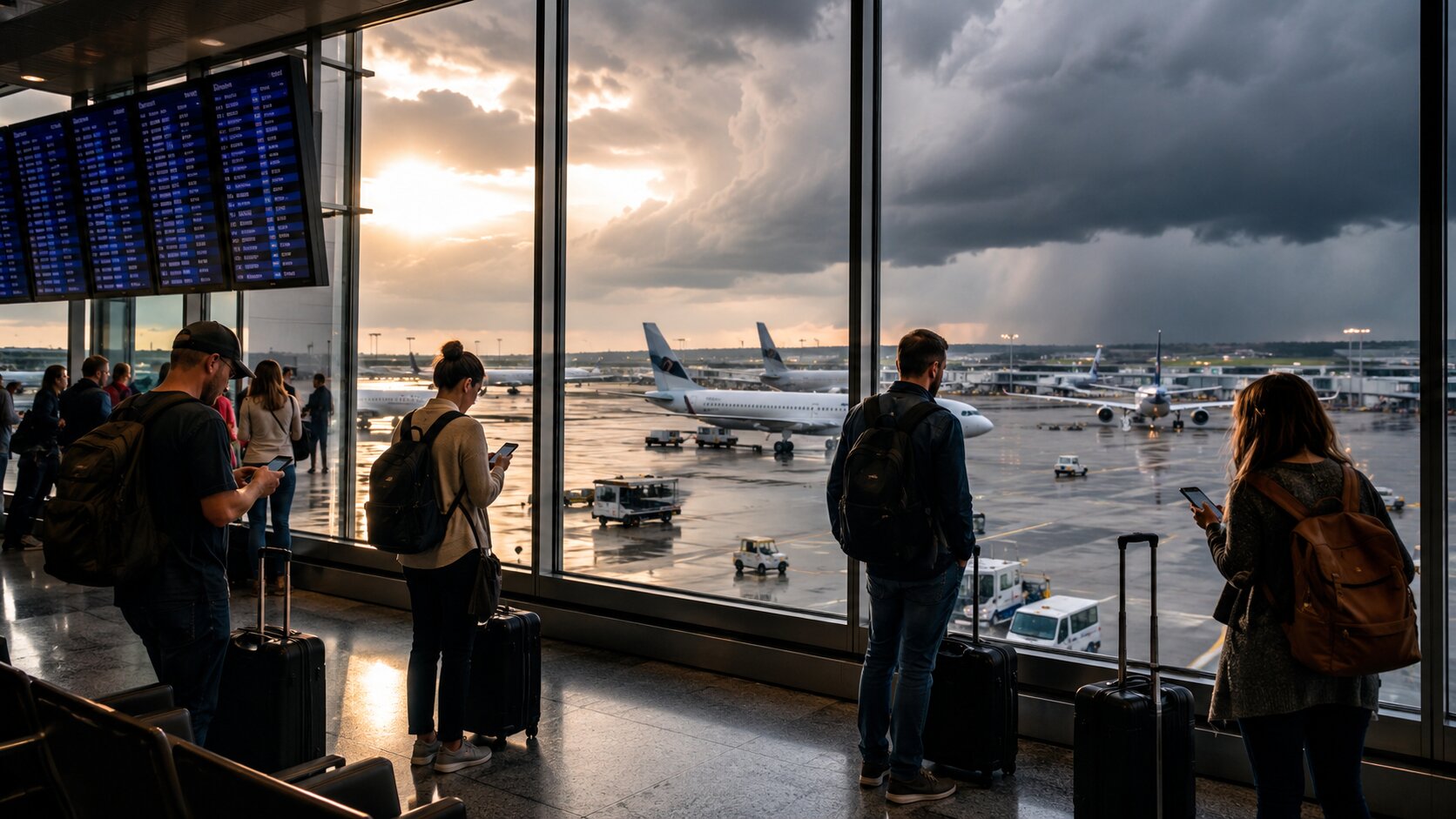
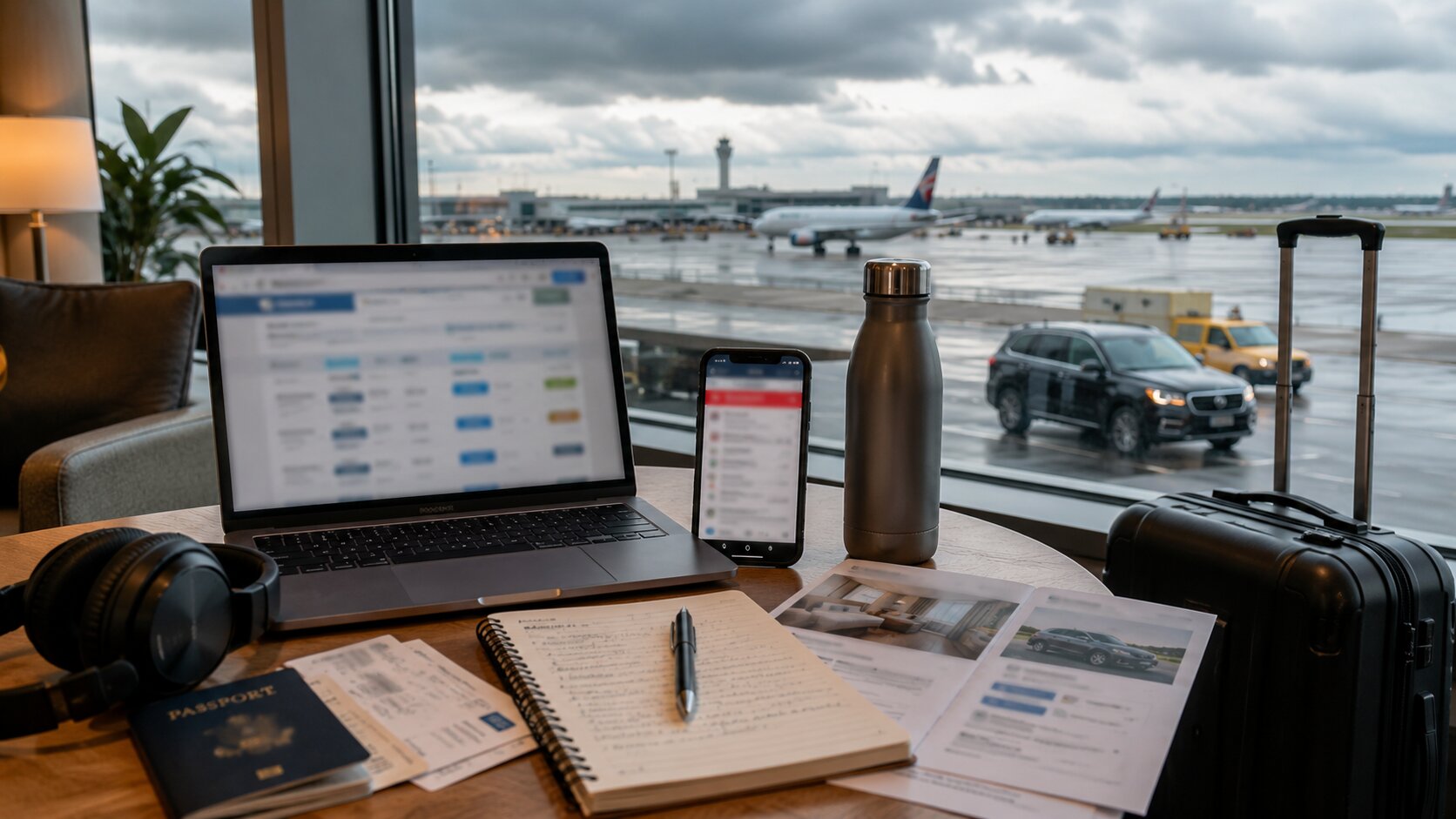
Summer thunderstorms can disrupt flights hundreds of miles away from the storm itself, particularly when they affect busy hubs or narrow air traffic corridors. Morning departures, nonstop routes, longer connections and flexible hotel or transfer bookings generally offer more protection. Before paying, check the entire aircraft route, the airline’s weather-waiver policy and what happens to your accommodation and airport transport if you arrive late.
A clear forecast at your departure airport does not necessarily mean your flight will operate on time. A thunderstorm over New York, Atlanta, Chicago, Dallas or Washington can close arrival routes, reduce runway capacity and delay aircraft scheduled to operate several more flights later that day.
That risk became especially visible again on July 21, 2026. The Federal Aviation Administration listed thunderstorm-related ground stops at several airports, including New York JFK, LaGuardia and Newark, as well as Boston, Baltimore, Washington Dulles, Reagan National and Nashville. Flights elsewhere could still be affected because aircraft and crews move through several cities during a single operating day.
For travelers, the important question is not simply whether thunderstorms are forecast. It is whether the itinerary leaves enough room to recover if the first delay develops into a missed connection, a lost hotel night or an airport transfer that has already departed.
This guide explains how to assess that risk before booking, which flight options are more resilient and what to confirm with airlines, hotels, taxi companies and transfer providers.
Key Takeaways
Point
Details
Morning flights usually carry less accumulated delay
Summer thunderstorms commonly develop later in the day, while aircraft and crew delays also build as the schedule progresses.
A sunny airport can still have delayed flights
Weather at the destination, along the route or at an earlier aircraft stop can affect your departure.
Nonstop flights reduce failure points
Every connection introduces another airport, aircraft movement and weather window.
Weather waivers can improve rebooking options
Airlines may temporarily allow changes without normal fees, but airports, dates and ticket conditions vary.
Hotel and transfer policies matter
A late arrival can create no-show charges, missed pickup fees or expensive last-minute transport.
Refund rights are not the same as compensation
A cancelled or significantly changed flight may qualify for a refund if you decline travel, but weather delays do not automatically produce cash compensation.
The July Disruption That Exposed the Network Risk
The July 21 event was not limited to one airport. FAA notices showed simultaneous operational restrictions across several major travel regions, including the Northeast and Mid-Atlantic.
This matters because those airports are not isolated destinations. They are major gateways for domestic journeys, transatlantic arrivals and connecting traffic. When thunderstorms block arrival paths or reduce the number of aircraft an airport can safely handle, the FAA may introduce measures such as:
Ground stops: affected flights are temporarily held at their departure airports.
Ground delay programmes: arrivals are metered and aircraft receive later departure times.
Reroutes: aircraft are directed around thunderstorms, potentially increasing flying time and congestion.
Airborne holding: aircraft circle before landing, subject to fuel and safety limits.
A passenger flying from Miami to Boston may be delayed because Boston cannot accept the scheduled number of arrivals. A traveler leaving London for a connection in Newark may depart on time but reach the United States after the onward flight has already been cancelled.
Aircraft rotations create another problem. The plane scheduled for an evening departure from a dry airport may still be operating an earlier segment through a storm-affected hub. By the time it reaches the passenger’s airport, both the aircraft and crew may be several hours behind schedule.
Pro Tip: Check the inbound aircraft when possible, not only your own flight number. An aircraft that has not yet left a storm-affected city is an early warning that the published departure time may change.
Check the Flight Path, Not Only the Local Forecast
Weather applications are useful, but a city-level forecast is not a complete flight-risk assessment.
The FAA explains that thunderstorms can force aircraft into holding patterns, diversions and alternative routes. Weather at a destination or elsewhere in the national airspace can delay a flight even when conditions at the passenger’s departure airport appear clear.
Before booking, examine four separate locations.
Your Departure Airport
Check whether the airport regularly experiences afternoon thunderstorms during your travel period. Atlanta, Orlando, Miami, Dallas, Houston, Denver and major Northeast airports can all experience summer convective disruption, although the timing and severity vary.
Your Arrival Airport
Arrival restrictions can hold your flight on the ground before departure. This is often safer and more efficient than sending aircraft toward an airport that cannot yet accept them.
Your Connecting Hub
A connection introduces two scheduled flights and at least three relevant weather zones: origin, hub and destination. A storm at the hub can break the itinerary even when both endpoints remain clear.
The Aircraft’s Previous Route
Airlines use the same aircraft for several segments. A previous delay can move through the schedule like a chain reaction.
No passenger tool can predict every operational decision. The goal is not certainty, but identifying whether the itinerary has several overlapping risk factors.
Build a Storm-Resilient Itinerary Before Paying
Travelers do not need to avoid the United States in summer. They should, however, compare itineraries on resilience as well as price.
Prefer an Early Departure
Mid-afternoon summer flights are often more exposed to disruption because peak heat overlaps with a busy airport period and the time when thunderstorms frequently develop.
An early flight also gives the airline more same-day rebooking options if something goes wrong. The final evening departure may leave no recovery option until the following morning.
Choose Nonstop When the Price Difference Is Reasonable
A one-stop ticket may be cheaper, but the apparent saving can disappear after a missed connection, unplanned meal, airport hotel or replacement transfer.
Nonstop travel removes one airport and one scheduled departure from the journey. It does not remove weather risk, but it reduces the number of points where disruption can break the itinerary.
Avoid Minimum-Length Connections
A legal connection is not always a sensible summer connection.
A 45-minute domestic transfer may work on a normal day but leave almost no margin when arrival traffic is being metered. International passengers may also need time for immigration, baggage collection, customs and terminal changes.
For an important journey, consider a longer connection or an overnight stop booked deliberately rather than created unexpectedly by a cancellation.
Compare Nearby Airports Carefully
Alternative airports can provide more flight choices, but the ground journey matters.
For New York, compare JFK, Newark and LaGuardia alongside the location of your hotel. For Washington, compare Dulles, Reagan National and Baltimore only after checking transfer time and late-night transport. In South Florida, Miami, Fort Lauderdale and Palm Beach may serve different airlines and routes.
A cheaper alternative is not necessarily better if a late arrival requires a long taxi journey or if public transport has stopped operating.
Examine Frequency, Not Just Departure Time
A route with four daily flights offers more recovery possibilities than a route served once per day. When comparing similar fares, look at how many later departures the airline operates and whether it has partner-airline rebooking options.
Booking situation
Lower-risk choice
Main trade-off
Fixed event the next morning
Arrive one day earlier
Additional hotel night
Domestic route with several departures
Morning nonstop flight
Possibly higher fare
International trip with a U.S. connection
Longer connection or direct service
Longer journey or higher price
Budget weekend break
Flexible flight and cancellable hotel
Higher initial booking cost
Last flight of the day
Earlier departure where possible
Less time at origin
Protect the Hotel Night and Airport Transfer
Flight disruption often becomes more expensive after landing arrangements start to fail.
Read the Hotel’s No-Show Terms
A refundable rate may still have a cancellation deadline several hours or days before arrival. Once that deadline passes, the hotel may charge the first night even when a flight is delayed by weather.
Confirm:
The latest guaranteed check-in time.
Whether reception operates overnight.
How to notify the property about a late arrival.
Whether the booking remains valid after midnight.
What happens if the flight is moved to the following day.
Contact the hotel directly as soon as the airline changes your itinerary. Do not assume the booking platform or airline will notify the property.
Check Transfer Waiting-Time Limits
A pre-booked airport transfer may include flight tracking, but that does not always mean unlimited waiting.
Review the provider’s rules for:
Included waiting time.
Rescheduled or diverted flights.
Arrival at a different terminal.
Additional parking or waiting charges.
Cancellation after the driver has been dispatched.
Contact procedures when mobile service is unavailable.
For families, groups and travelers carrying specialist equipment, a flexible private transfer may be more practical than finding a suitable vehicle after midnight.
Keep a Taxi Fallback
Save the location of the official airport taxi rank and check whether taxis accept cards. Avoid accepting unsolicited rides from drivers approaching passengers inside the terminal.
Also check the cost and operating hours of trains, buses or metro services. A flight arriving two hours late may land after the final public transport departure, changing the real cost of the trip.
Know What the Airline Owes During a Weather Delay
U.S. refund rules and airline service commitments are frequently confused.
Under U.S. Department of Transportation rules, a passenger is entitled to a refund when an airline cancels a flight for any reason and the passenger chooses not to travel or accept an alternative. A refund may also apply when an itinerary is significantly delayed or changed and the passenger declines the revised journey.
The Department of Transportation defines significant timing changes as arrival or departure differences of at least three hours for a domestic itinerary or six hours for an international itinerary. Other qualifying changes can include a different origin or destination airport, additional connections or an involuntary downgrade.
However, accepting the airline’s replacement flight generally means giving up the refund for the unused ticket.
Cash compensation, hotel accommodation and meals are separate issues. U.S. airlines publish commitments for disruptions within their control, but thunderstorms are normally treated as weather events outside the airline’s control. Complimentary hotels and meals should therefore not be assumed.
Travelers should still ask the airline what it can provide. Operational problems can have several causes, and carriers may offer assistance, travel waivers or goodwill support even when it is not legally required.
Keep receipts for hotels, meals and replacement transport. Travel insurance or card benefits may reimburse eligible costs, subject to exclusions, delay thresholds and documentation requirements.
Should You Book Now, Wait or Change the Itinerary?
Thunderstorm risk alone is not usually a reason to postpone an entire summer trip. Storm development can be highly localised, and forecasts become more useful closer to departure.
The better decision depends on how much disruption the journey can tolerate.
Book now with flexible terms when fares or hotel availability are likely to tighten, but choose a morning flight, sensible connection and cancellable accommodation.
Wait before booking a non-refundable trip when the journey is optional, dates are flexible and the only available itineraries involve late flights or tight connections through storm-prone hubs.
Change the itinerary when missing the arrival time would cause a significant consequence, such as losing a cruise departure, wedding, business meeting, tour or separate non-refundable flight.
Add a buffer day when the event cannot move. The additional hotel night may cost less than replacing multiple bookings after a same-day disruption.
A weather waiver can also change the calculation. Airlines may temporarily permit eligible passengers to move their travel dates without the normal change fee or fare difference. Exact eligibility depends on the airline, affected airports, ticket date and rebooking deadline.
Practical Thunderstorm Booking Checklist
Compare morning and afternoon departures.
Prefer a nonstop flight where the total cost remains reasonable.
Avoid the final departure of the day for time-sensitive trips.
Check the connection time against immigration and terminal requirements.
Look at the airline’s number of later flights on the same route.
Compare nearby airports with the full ground-transfer cost included.
Review the airline’s change, refund and weather-waiver rules.
Choose a hotel with suitable cancellation and late-arrival terms.
Tell the hotel when a delayed flight could push check-in past midnight.
Confirm transfer waiting time, flight tracking and rescheduling fees.
Save official taxi-rank and public transport information.
Keep airline, hotel and transfer confirmations accessible offline.
Check FAA and airline updates before leaving for the airport.
Keep receipts if disruption creates additional expenses.
Consider insurance when several non-refundable bookings depend on one flight.
Compare the Whole Journey with AroundTravel
A low airfare is only one part of a storm-sensitive summer itinerary. Hotel flexibility, airport location, transfer availability and alternative transport can become equally important when a flight arrives several hours late.
Use AroundTravel to compare relevant travel options, including flights, hotels, airport transfers, taxis and related services. Evaluate the complete journey before booking rather than choosing each component solely on its headline price.
Frequently Asked Questions
Why is my flight delayed when the weather at my airport is clear?
The aircraft may be arriving from a storm-affected airport, or thunderstorms may be blocking its route or destination. Air traffic restrictions elsewhere can therefore delay a flight from an airport with clear skies.
Are morning flights less likely to be delayed by thunderstorms?
They are generally less exposed to afternoon storm development and accumulated operational delays. A morning flight is not guaranteed to operate on time, but it usually provides more recovery options than the last flight of the day.
Should I avoid connecting through New York during summer?
Not automatically. New York offers extensive route choice, but travelers should avoid very short connections and monitor weather advisories affecting JFK, LaGuardia and Newark. A direct flight or longer connection may be preferable for a time-sensitive journey.
Will an airline pay for my hotel after a weather cancellation?
Not necessarily. U.S. airline hotel commitments commonly apply to controllable disruptions, while thunderstorms are normally outside the airline’s control. Ask the carrier, check its customer-service policy and review any travel insurance benefits.
Can I receive a refund when a thunderstorm cancels my flight?
Yes, when the airline cancels the flight and you choose not to travel or accept an alternative. If you accept rebooking, the automatic ticket-refund right generally no longer applies to that itinerary.
What happens to a pre-booked airport transfer if my flight is delayed?
It depends on the provider. Some monitor flight arrivals and adjust pickup times, while others impose waiting limits or additional charges. Confirm the policy before booking and contact the driver or dispatch team when your flight changes.
Is a refundable flight always worth the extra cost?
It can be valuable when the trip involves a fixed event, separate tickets, expensive accommodation or limited alternative flights. For a flexible journey with frequent service, a standard fare with suitable change terms may be sufficient.
Sources Used
Federal Aviation Administration
National Weather Service
U.S. Department of Transportation
Delta Air Lines
United Airlines
Jonas DuPont
An avid traveler and seasoned writer who has journeyed across more than 40 countries, sharing his unique experiences and insights with a growing audience of adventure seekers and travel enthusiasts. With a passion for discovering hidden gems and immersing himself in diverse cultures, Jonas's travel blog combines practical tips, stunning photography, and captivating storytelling. Whether he's navigating bustling city streets or exploring remote landscapes, Jonas offers readers an authentic glimpse into the world's most fascinating destinations, inspiring them to embark on their own unforgettable journeys.
Providing You With Access To The Top Travel Destinations. Book Now and Enjoy!
TESTIMONIALS
Travelers Reviews
Planning a trip used to be a stressful event, until I found Around
Travel. The website made everything so easy and convenient and really has made
travelling a relaxing experience. I highly recommend using them.
Sam Wistan Marketing Consultant, USA
I travel a lot for business and making reservations used to take up so
much time. Around Travel offers me quick access to all my booking needs.
Jonas DuPont Investment Advisor, London
I am a spur of the moment type of girl and I like to book trips at a
whim. Around Travel always has great deals and options for me to choose from.