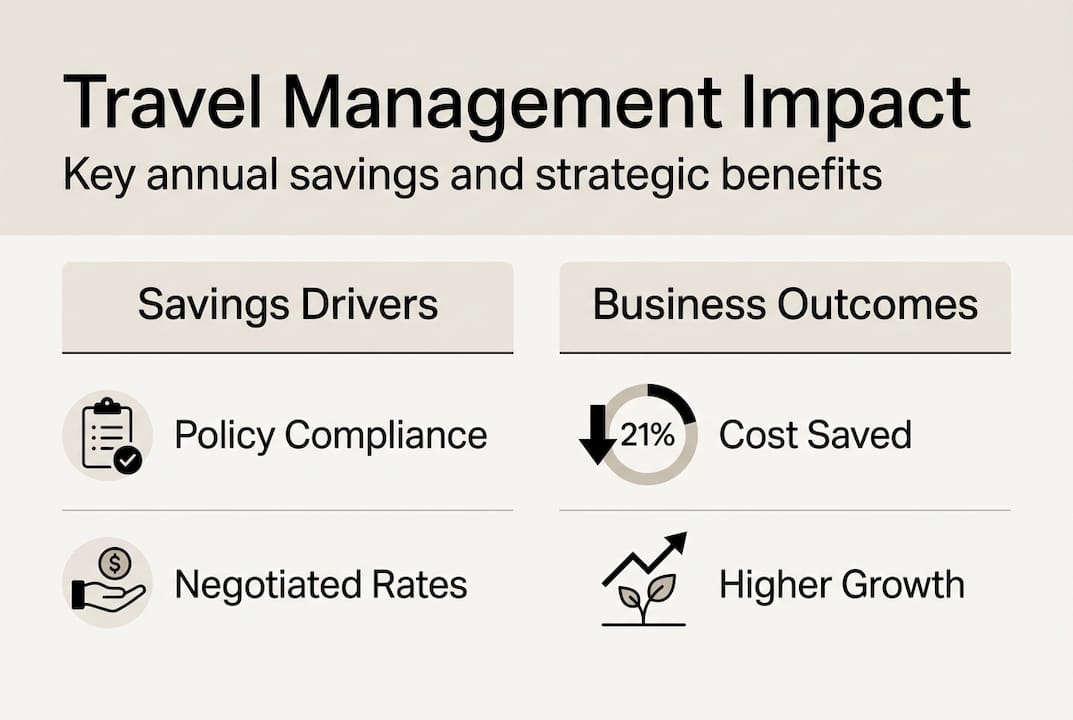
Strategic travel management transforms how organizations control costs and enhance traveler experiences, yet many still view it as simple trip booking. Companies with integrated travel programs see a 26% increase in policy compliance and 21% annual cost savings, proving that effective management delivers measurable financial impact. This article explores how travel management functions across corporate and leisure sectors, the methodologies that drive efficiency, and practical applications that optimize every trip.
Centralized platforms streamline approvals, expense tracking, and policy enforcement.
TMC value proposition
Travel management companies offer 24/7 traveler support, better negotiated rates, and duty of care services.
What is travel management: roles and core functions
Travel management in corporate settings encompasses planning, booking, policy enforcement, expense tracking, duty of care, and supplier negotiation to optimize costs, efficiency, and safety. Travel managers serve as strategic partners who balance organizational needs with traveler satisfaction, ensuring every trip aligns with budget constraints and compliance requirements. They negotiate corporate rates with hotels and airlines, implement booking tools that capture travel data, and maintain traveler safety protocols during disruptions.
Leisure travel management takes a different approach, focusing on personalized itineraries, group coordination, and customer experience rather than strict policy enforcement. Leisure travel coordinators build relationships with tour operators, manage group bookings for family reunions or destination events, and craft custom experiences that match client preferences. While corporate managers track compliance metrics, leisure coordinators measure satisfaction scores and repeat booking rates.
Both sectors share the fundamental goal of optimizing traveler experience while maximizing value. Corporate travel managers must balance cost control with employee satisfaction to maintain productivity and retention. Leisure coordinators balance personalization with operational efficiency to serve multiple clients simultaneously. The core functions differ in execution but converge on delivering seamless travel experiences that meet distinct stakeholder expectations.
Key responsibilities across both sectors include:
Negotiating supplier contracts for competitive rates and favorable terms
Implementing booking systems that capture data and ensure policy adherence
Managing traveler communications before, during, and after trips
Coordinating emergency support and duty of care protocols
Analyzing travel data to identify cost savings opportunities
Pro Tip: Use vacation planning services to streamline itinerary creation and reduce coordination time by 40%, freeing resources for strategic planning. Review Travelstart services and credibility to understand how booking platforms maintain quality standards.
Key methodologies and tools in travel management
Centralized booking platforms and automation tools form the backbone of modern travel management, streamlining approvals, expense tracking, and policy compliance. These systems integrate with corporate financial software to capture every transaction, flag out-of-policy bookings before purchase, and generate real-time reporting dashboards. Travel managers gain visibility into spending patterns, identify frequent travelers who qualify for loyalty programs, and negotiate volume-based discounts with preferred suppliers.
Travel Management Companies (TMCs) provide specialized expertise that internal teams often lack, negotiating better rates and offering 24/7 support for travelers worldwide. TMCs leverage industry relationships to secure corporate discounts averaging 15-25% below published rates, handle complex itinerary changes during disruptions, and provide duty of care services that track traveler locations during emergencies. They also manage visa applications, travel insurance coordination, and supplier issue resolution.
Integrated platforms yield measurable results, with organizations reporting 26% compliance increases and 21% annual cost reductions after implementation. Real-time traveler tracking enhances duty of care by alerting managers to weather disruptions, political unrest, or health emergencies affecting their teams. Automated approval workflows reduce booking cycle times from days to hours, while expense management integration eliminates manual receipt processing.
Essential tool categories include:
Booking platforms with policy engines that prevent non-compliant purchases
Expense management systems that auto-populate transactions from booking data
Traveler tracking solutions with geofencing and emergency alert capabilities
Analytics dashboards that visualize spending trends and savings opportunities
Mobile apps that provide itinerary access and real-time travel updates
Tool Type
Primary Benefit
Implementation Impact
Centralized Booking
Policy compliance
26% increase in adherence
TMC Partnership
Cost savings
15-25% rate reductions
Automation
Efficiency gains
60% faster approvals
Traveler Tracking
Duty of care
90% faster emergency response
Pro Tip: Mandate booking tool usage to eliminate leakage from direct supplier bookings that bypass negotiated rates and policy controls. Check Travelstart services for platform features and explore latest travel news for industry tool updates.
Corporate vs leisure travel management: differences and overlap
Corporate travel management prioritizes policy enforcement, cost control, and risk management, while leisure management emphasizes personalized experiences, group coordination, and customer satisfaction. Corporate programs implement strict booking windows, preferred supplier requirements, and expense approval hierarchies that ensure financial accountability. Finance teams integrate travel data with accounting systems to track departmental budgets and forecast quarterly spending.
Leisure travel coordinators operate with greater flexibility, building custom itineraries that match client preferences rather than enforcing standardized policies. They focus on creating memorable experiences through unique accommodations, curated activities, and seamless logistics for family groups or special events. Customer retention depends on exceeding expectations rather than minimizing costs, shifting the value equation toward satisfaction metrics.
The bleisure trend blends both approaches, with 54% of business travelers extending trips for personal time in 2024. This creates management challenges around expense allocation, duty of care boundaries, and policy application during personal portions of trips. Organizations must establish clear guidelines for splitting costs, define when corporate travel insurance applies, and communicate expectations about availability during leisure extensions.
Corporate enforces class of service limits; leisure offers premium upgrades
Pro Tip: Create separate bleisure policies that clearly define personal expense responsibility and duty of care coverage to avoid confusion and liability issues. Explore vacation planning tools for leisure components.
Business impact and challenges in strategic travel management
Strategic travel management links to revenue growth, with companies showing 30% higher revenue when managing travel spend effectively. Research demonstrates that each 1% increase in managed travel spend correlates with 0.20% revenue growth, proving that travel investment drives business outcomes. Organizations that view travel as strategic enablement rather than cost center see stronger sales performance, better client relationships, and improved employee retention.
Managing guest and non-employee travel presents unique challenges including payment processing, policy application, and duty of care responsibilities. Virtual credit cards solve payment issues by generating single-use numbers with spending limits, while traveler profiling systems capture preferences without full employee onboarding. Guest travel requires clear policies about booking channels, expense reimbursement, and emergency support availability.
Geopolitical risks, VAT recovery complexity, and bleisure expense allocation create additional management burdens that require specialized expertise. Travel managers must monitor State Department advisories, implement risk assessment frameworks, and maintain evacuation protocols for high-risk destinations. VAT reclaim processes vary by country and require detailed documentation that automated systems help capture. Bleisure trips need expense splitting rules that clearly separate business meals, transportation, and lodging from personal costs.
Critical challenges include:
Tracking travelers across multiple time zones and jurisdictions
Recovering VAT on international business expenses
Balancing traveler satisfaction with cost containment
Managing supplier relationships during market disruptions
Implementing duty of care frameworks like ISO 31030
Pro Tip: Adopt ISO 31030 standards for travel risk management to establish comprehensive duty of care protocols that protect travelers and limit organizational liability. Review refunds policy frameworks and visa travel documentation requirements before international trips.
Strategic travel management is not an expense to minimize but an investment that enables business growth, protects travelers, and strengthens organizational performance when executed with clear policies and appropriate technology.
Applying software and standards for optimized travel management
Mandating booking tool usage reduces leakage and captures travel data that informs negotiation strategies and policy refinement. When organizations require all bookings through approved platforms, they gain visibility into spending patterns, identify opportunities for volume consolidation, and enforce policy compliance before purchases occur. This mandate typically increases managed spend from 60-70% to 85-95% of total travel expenditure.
Automation streamlines approvals, expense reporting, and traveler tracking while reducing administrative burden by 50-70%. Workflow engines route booking requests based on trip cost, destination risk level, or traveler seniority, applying appropriate approval hierarchies automatically. Expense systems pull transaction data directly from booking platforms, eliminating manual receipt entry and reducing processing time from weeks to days.
Standards like ISO 31030 improve duty of care by establishing risk assessment protocols, communication procedures, and emergency response frameworks. These standards help organizations identify high-risk destinations, implement pre-travel briefings, and maintain 24/7 traveler contact capabilities. Compliance demonstrates governance maturity to stakeholders and reduces liability exposure during travel incidents.
Implementation priorities:
Select booking platforms with robust policy engines and mobile access
Integrate expense management systems with booking and accounting software
Establish TMC partnerships for rate negotiation and traveler support
Implement traveler tracking with geofencing and emergency alert capabilities
Develop policy frameworks that balance control with traveler satisfaction
Train travelers on tool usage and policy requirements through interactive modules
Monitor compliance metrics and adjust policies based on data insights
Software selection differs between corporate finance integration needs and leisure itinerary management requirements. Corporate platforms prioritize approval workflows, expense capture, and reporting capabilities that satisfy financial controls. Leisure systems emphasize itinerary presentation, customer communication, and group coordination features that enhance service delivery.
Pro Tip: Use data analytics to identify policy friction points where travelers frequently request exceptions, then refine policies to balance compliance with reasonable flexibility. Explore visa travel documents management and AI travel assistant capabilities for automated support. Review hotel booking tools for platform comparisons.
Enhance your travel management with Around Travel solutions
Navigating complex travel logistics requires expert support and integrated tools that simplify every booking decision. Around Travel provides comprehensive resources that help travel managers optimize arrangements while maintaining policy compliance and traveler satisfaction.
Access dedicated support teams for booking assistance, itinerary changes, and refund processing through our streamlined refunds policy framework. Leverage efficient car rental services and taxi services integrated directly with your travel management platform for seamless ground transportation coordination. Our solutions combine booking efficiency with personalized service, delivering the control corporate programs need and the flexibility leisure coordinators value.
Whether managing corporate travel programs or coordinating group leisure trips, Around Travel’s platform provides the tools, supplier relationships, and expert guidance that transform travel management from administrative burden into strategic advantage.
FAQ
What does a travel manager do in a corporate setting?
Corporate travel managers oversee bookings, enforce travel policies, track expenses, ensure traveler safety, and negotiate supplier contracts. They implement booking systems that capture data, analyze spending patterns to identify savings opportunities, and maintain duty of care protocols during disruptions. Their role balances cost control with employee satisfaction to support business objectives.
How does leisure travel management differ from corporate travel management?
Leisure travel management focuses on personalized itineraries, group coordination, and customer experience rather than strict policy compliance. Leisure coordinators build custom trips matching client preferences, manage family or event group bookings, and measure success through satisfaction scores. Corporate management prioritizes efficiency, cost control, and policy enforcement with standardized processes.
What are the main tools used to improve travel management efficiency?
Centralized booking platforms with policy engines, Travel Management Companies for negotiated rates, automation tools for approvals and expense tracking, and real-time traveler tracking systems form the core technology stack. These tools increase policy compliance by 26%, reduce costs by 21% annually, and streamline administrative tasks. Integration with financial systems provides comprehensive spending visibility.
How can travel managers address challenges like bleisure and guest travel?
Establish clear policies defining personal expense responsibility during bleisure trips, use virtual credit cards for guest traveler payments, and implement traveler profiling systems that capture preferences without full onboarding. Apply duty of care standards like ISO 31030 to clarify coverage boundaries and emergency support availability. Communicate expectations explicitly before trips begin.
Why is strategic travel management important for business performance?
Strategic travel management drives measurable business outcomes, with companies showing 30% higher revenue when managing spend effectively. Each 1% increase in managed travel spend correlates with 0.20% revenue growth by enabling sales activities, strengthening client relationships, and supporting employee productivity. Effective management also ensures compliance, protects travelers, and optimizes resource allocation.
An avid traveler and seasoned writer who has journeyed across more than 40 countries, sharing his unique experiences and insights with a growing audience of adventure seekers and travel enthusiasts. With a passion for discovering hidden gems and immersing himself in diverse cultures, Jonas's travel blog combines practical tips, stunning photography, and captivating storytelling. Whether he's navigating bustling city streets or exploring remote landscapes, Jonas offers readers an authentic glimpse into the world's most fascinating destinations, inspiring them to embark on their own unforgettable journeys.
Providing You With Access To The Top Travel Destinations. Book Now and Enjoy!
TESTIMONIALS
Travelers Reviews
Planning a trip used to be a stressful event, until I found Around
Travel. The website made everything so easy and convenient and really has made
travelling a relaxing experience. I highly recommend using them.
Sam Wistan Marketing Consultant, USA
I travel a lot for business and making reservations used to take up so
much time. Around Travel offers me quick access to all my booking needs.
Jonas DuPont Investment Advisor, London
I am a spur of the moment type of girl and I like to book trips at a
whim. Around Travel always has great deals and options for me to choose from.