Think about the last time you stood in line for two hours just to see a famous landmark, surrounded by hundreds of strangers all holding up their phones. Now imagine standing at the edge of a misty valley in a country most people can’t point to on a map, with a local family inviting you in for tea. 80% of travelers visit only 10% of the world, which means the other 90% is sitting there, largely untouched, waiting for curious people like you. This article breaks down why that matters, what you’re actually missing, and how to start exploring beyond the obvious.
Key Takeaways
Point
Details
Authentic experiences
Offbeat travel offers deeper cultural connection and memorable stories you can’t find in crowded hotspots.
Sustainable impact
Choosing lesser-known places helps protect environments and supports local communities globally.
Balanced travel
Offbeat destinations offer new adventures but require flexible planning compared to the reliability of mainstream spots.
Informed preparation
Do your research and plan ahead to overcome any infrastructure or accessibility challenges off the beaten path.
Why are most travelers missing out?
The numbers are striking. The top 50 EU markets receive 48% of all traveler reviews, yet they cover only 0.16% of European territory. That’s an enormous concentration of attention on a tiny slice of the map. Meanwhile, thousands of towns, coastlines, and cultural sites across the continent go almost completely unnoticed.
The situation is even more extreme in specific hotspots. Mallorca, for example, records 44 nights per resident annually, compared to the EU average of just 6. That’s not a travel destination anymore. That’s a pressure cooker.
So why do travelers keep going to the same places? Three forces drive it: convenience, reputation, and groupthink. People book what they recognize, trust what others have reviewed, and follow the crowd because it feels safe. The result is a self-reinforcing loop where popular places get more popular, and everywhere else gets forgotten.
“The forgotten majority of destinations aren’t undiscovered because they lack value. They’re overlooked because the travel industry hasn’t pointed a spotlight at them yet.”
This is exactly why places like Bhutan’s exclusive tourism model stand out. Bhutan deliberately limits visitor numbers, and the result is one of the most meaningful travel experiences on the planet.
What travelers miss by sticking to hotspots:
Genuine local culture, not a performance of it
Affordable prices before tourism inflation sets in
Landscapes and heritage sites without the crowds
The chance to be a guest, not just a tourist
The unique thrills and authentic experiences of offbeat travel
Here’s a number worth sitting with: nearly 70% of travelers report their most memorable trips happened off the beaten path. Not at the Eiffel Tower. Not in Times Square. In places most people haven’t heard of.
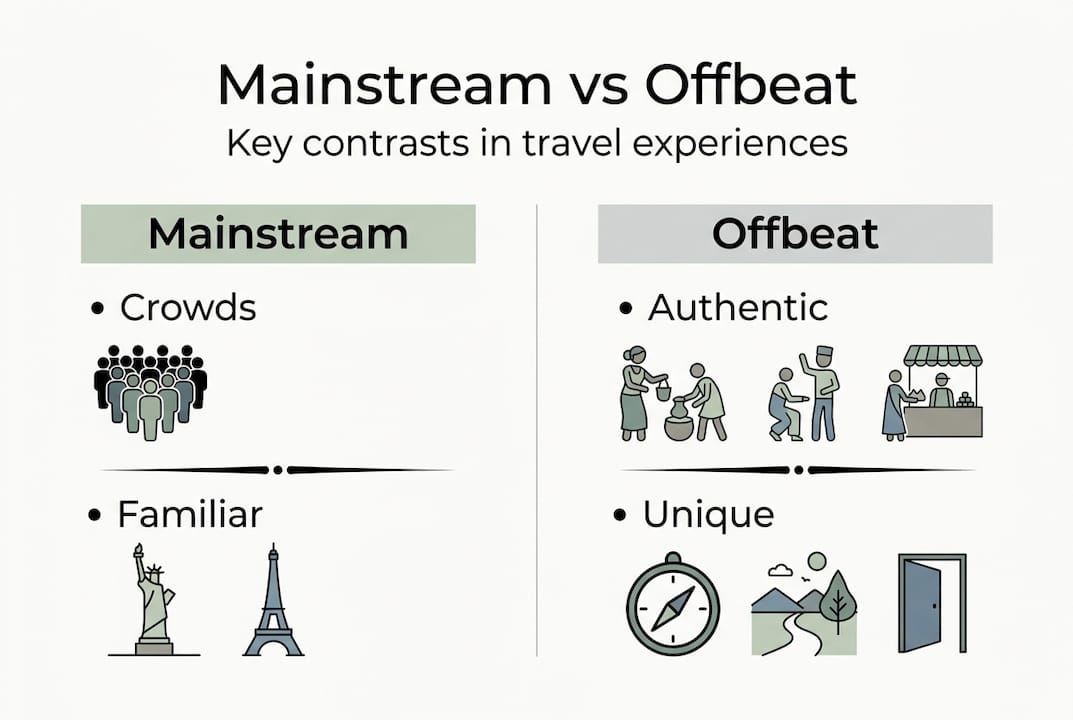
That’s not a coincidence. Offbeat destinations provide deeper cultural connections because locals haven’t been worn down by years of mass tourism. They’re curious about you. They want to share their food, their stories, their traditions. That kind of exchange is almost impossible in a place where tourists outnumber residents.
And the demand is growing. 45% of niche tourists actively seek unique experiences as their primary travel motivation. People are tired of checking boxes. They want stories worth telling.
Factor
Mainstream destination
Offbeat destination
Crowd levels
High to extreme
Low to moderate
Cost
Often inflated
Generally affordable
Cultural authenticity
Diluted by tourism
Genuine and immersive
Memorability
Familiar, expected
Surprising, personal
Local interaction
Transactional
Meaningful
If you’re drawn to immersive travel experiences, offbeat destinations are where those experiences actually happen. Even something as simple as staying at a family-run inn, like the kind you’d find in Salzburger Land, can completely change how you relate to a place.
Pro Tip: Before visiting a lesser-known community, spend 30 minutes learning five phrases in the local language and reading about one local custom. Locals notice the effort, and it opens doors that money simply can’t buy.
Travel with purpose: sustainability and the impact of undertourism
Visiting offbeat places isn’t just good for you. It’s good for the planet and the people who live there. Offbeat tourism promotes sustainability by distributing economic benefits across more communities, rather than funneling all travel dollars into a handful of already-strained destinations.
When you spend money in a lesser-visited town, that money stays local. It supports the guesthouse owner, the market vendor, the local guide. In overtouristed areas, a large share of revenue flows to international hotel chains and tour operators based elsewhere.
“Spreading tourism flow is one of the most effective tools we have for protecting both natural environments and cultural heritage.”
The Beyond Capacity White Paper confirms that diversifying tourist flow is a key benchmark for long-term sustainability. It’s not just an ethical choice. It’s a practical one.
How to travel more responsibly right now:
Choose locally owned accommodations over international chains
Hire local guides instead of booking through large tour operators
Visit during shoulder seasons to avoid adding to peak-time pressure
Spend at local markets, restaurants, and artisan shops
Learn about and respect local environmental guidelines
Even small choices add up. Travelers who stay at places like Bangkok’s design hostels that prioritize community and sustainability are already making a difference without sacrificing comfort.
The real-world trade-offs: challenges of offbeat exploration
Let’s be honest. Offbeat travel isn’t always smooth. There are real trade-offs, and pretending otherwise would be doing you a disservice.
Some lesser-known destinations lack reliable public transport, consistent internet access, or well-equipped medical facilities. Language barriers can be more significant. Payment infrastructure may be limited to cash only. And if a destination suddenly goes viral, infrastructure gaps can become serious problems almost overnight.
Mainstream destinations exist for a reason. They’ve invested in tourist infrastructure, multilingual support, and reliable booking systems. If you need predictability, a well-trodden path delivers it.
Common challenges in offbeat travel and how to handle them:
Limited transport: Research local bus routes, shared taxis, or rental options well in advance
Healthcare access: Get comprehensive travel insurance and carry a basic medical kit
Language barriers: Download offline translation apps and carry a phrasebook
Cash dependency: Withdraw local currency before leaving major cities
Unreliable Wi-Fi: Get a local SIM card or a portable hotspot device
Understanding risks in emerging destinations before you go is part of smart travel planning. The goal isn’t to avoid challenges. It’s to walk into them prepared.
Pro Tip: Always have a printed backup of your accommodation address, emergency contacts, and key travel documents. In remote areas, your phone battery and signal are not guaranteed.
How to plan your offbeat adventure
The good news: 38% of US adults are already interested in niche and offbeat tourism. You’re not alone in this. The community of travelers seeking something different is bigger than you think, and the resources to help you plan are growing fast.
Here’s a practical step-by-step approach to finding and booking your next offbeat trip:
Start with curiosity, not a destination. Think about what kind of experience you want: mountain solitude, coastal villages, ancient ruins, food culture. Let the experience lead you to the place.
Use travel forums and local blogs. Reddit’s r/solotravel and r/travel communities are full of firsthand accounts from people who’ve been to places guidebooks ignore.
Evaluate accessibility and safety. Check government travel advisories, read recent traveler reports, and look at transport options before committing.
Research cultural etiquette. Every community has norms around dress, photography, and interaction. Knowing them in advance shows respect and keeps you out of awkward situations.
Book with local or sustainable operators. Use top travel planning tools to find vetted local experiences rather than generic packages.
Consider starting with an easy win. If full offbeat travel feels like a leap, try easy international getaway ideas that blend accessibility with authenticity.
Build in flexibility. Offbeat travel rewards spontaneity. Leave room in your itinerary for unexpected invitations, detours, and discoveries.
Destinations like Innsbruck show that offbeat doesn’t have to mean remote or difficult. Sometimes it just means choosing a place that most travelers overlook in favor of the obvious option next door.
Turn your next trip into an unforgettable adventure with Around Travel
You now have a clear picture of why offbeat travel matters and how to approach it. The next step is making it happen without the stress of piecing everything together on your own.
Around Travel is built for exactly this kind of journey. Whether you need car rentals for offbeat destinations to reach places public transport won’t take you, or taxi services for local journeys once you arrive, the platform covers the logistics so you can focus on the experience. From curated destination guides to flexible booking options for hotels, tours, and transport, Around Travel gives you the tools to explore confidently. When you’re ready to plan your offbeat adventure, you’ll find everything you need in one place, backed by a team that understands what meaningful travel actually looks like.
Frequently asked questions
What makes a destination ‘offbeat’?
An offbeat destination is one that receives far fewer tourists than mainstream spots and offers a unique, authentic experience. To put it in perspective, the top 50 EU markets covering just 0.16% of territory absorb nearly half of all traveler reviews, which shows just how concentrated mainstream tourism really is.
Are offbeat places always better than mainstream destinations?
Not always. While offbeat destinations offer authenticity and fewer crowds, mainstream spots often provide better infrastructure and more predictable value. As infrastructure gaps in suddenly popular places show, popularity without preparation can create real problems for travelers.
How can I find reliable local experiences in offbeat locations?
Connect with local guides, look for community tourism projects, and use platforms focused on cultural exchange. Deeper cultural connections are far more likely when you engage directly with the people who actually live in a place.
What are some risks of offbeat travel?
Limited infrastructure, language barriers, and health or safety considerations are the most common challenges. Potential infrastructure gaps are real, so always research thoroughly and plan for contingencies before you go.
Do offbeat destinations help with sustainable tourism?
Yes. Spreading tourism across more destinations supports sustainability by benefiting more communities and reducing pressure on global hotspots. Undertourism promotes sustainability by keeping economic benefits local and protecting environments that would otherwise be overwhelmed.
An avid traveler and seasoned writer who has journeyed across more than 40 countries, sharing his unique experiences and insights with a growing audience of adventure seekers and travel enthusiasts. With a passion for discovering hidden gems and immersing himself in diverse cultures, Jonas's travel blog combines practical tips, stunning photography, and captivating storytelling. Whether he's navigating bustling city streets or exploring remote landscapes, Jonas offers readers an authentic glimpse into the world's most fascinating destinations, inspiring them to embark on their own unforgettable journeys.
Providing You With Access To The Top Travel Destinations. Book Now and Enjoy!
TESTIMONIALS
Travelers Reviews
Planning a trip used to be a stressful event, until I found Around
Travel. The website made everything so easy and convenient and really has made
travelling a relaxing experience. I highly recommend using them.
Sam Wistan Marketing Consultant, USA
I travel a lot for business and making reservations used to take up so
much time. Around Travel offers me quick access to all my booking needs.
Jonas DuPont Investment Advisor, London
I am a spur of the moment type of girl and I like to book trips at a
whim. Around Travel always has great deals and options for me to choose from.