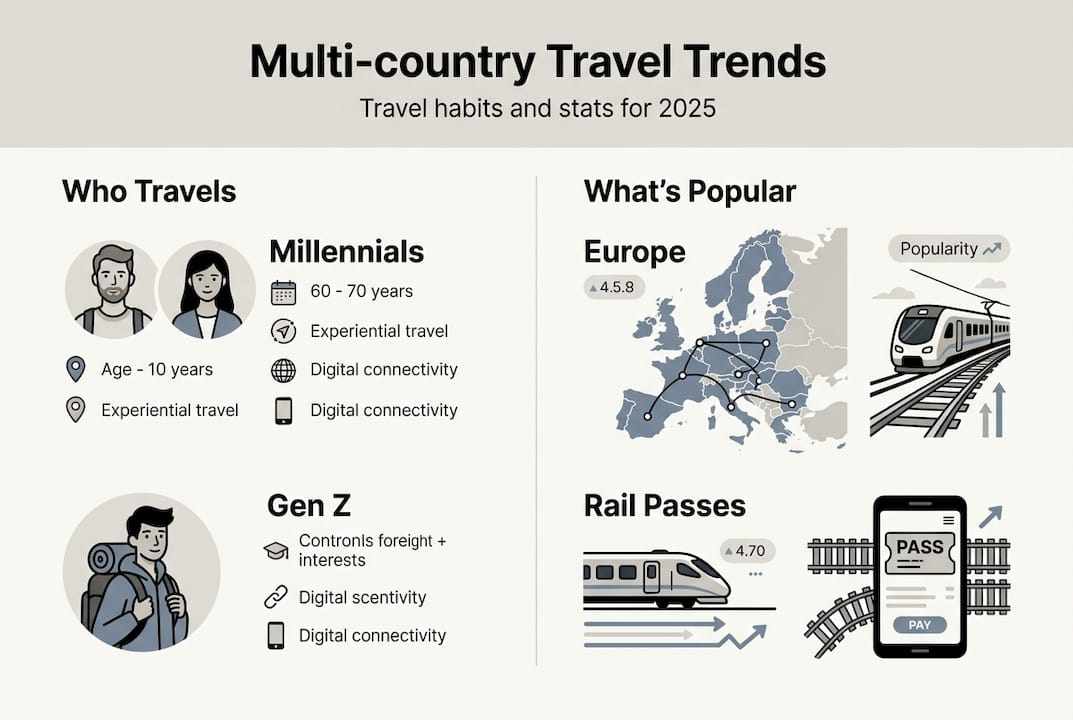
Multi-country travel is rapidly gaining popularity among younger generations seeking diverse experiences.
Planning and flexibility are key to managing logistics, avoiding fatigue, and enjoying cultural contrasts.
Proper planning and mindset can turn multi-country trips into memorable, enriching adventures.
Nearly one in four travelers is now planning multi-country trips, and it’s not hard to see why. Sticking to a single destination used to feel like the responsible choice, the easier one. But today’s traveler is rethinking that assumption. Multi-country itineraries offer something fundamentally different: the chance to wake up in Barcelona, take a train to Lisbon, and end the week sipping wine in the French countryside. This article breaks down why multi-country travel is surging, what genuine benefits it delivers, how to handle the real challenges, and how to decide whether it’s the right fit for your next trip.
Key Takeaways
Point
Details
Trend on the rise
Multi-country trips are more popular than ever among leisure travelers, offering fresh possibilities each year.
Maximize experience
Combining countries on one trip delivers unique cultures, greater value, and more efficient use of travel time.
Consider your goals: choose multi-country for adventure and variety, single-country for depth and relaxation.
The rise of multi-country travel
Something shifted after the pandemic. Travelers didn’t just want to get back out there. They wanted more. More cultures, more landscapes, more stories to bring home. That hunger pushed multi-destination itineraries from a niche preference into a mainstream travel style.
The numbers back this up. Nearly 25% of travelers are now planning multi-country trips in 2025, a notable jump from previous years. And the broader market signals the same direction: the leisure travel market is projected to reach $15 trillion by 2040, with multi-destination trips expected to triple during that period. That’s not a trend. That’s a structural shift in how people think about vacations.
Millennials and Gen Z are driving much of this change. These groups prioritize experiences over possessions, and a multi-country trip delivers variety that a single destination simply can’t match. Seeing three different cultures, cuisines, and landscapes in two weeks feels more rewarding than spending the same time in one place, at least for a growing share of travelers.
Travel style
2019 share
2025 share
Growth
Single-country trips
78%
62%
Declining
Multi-country trips
22%
38%
Rising fast
Europe remains the most popular region for this style of travel, and for good reason. Its geography makes border-crossing easy, and the density of autumn European destinations means you can pack enormous variety into a short trip. Whether you’re drawn to ancient history, coastal scenery, or vibrant city life, the continent rewards the curious traveler who refuses to stay in one lane.
For those mapping out their first multi-country route, starting with must-visit European cities is a smart entry point. The infrastructure is reliable, the distances are manageable, and the cultural contrasts between neighboring countries are striking enough to justify every border crossing.
The bottom line: multi-country travel isn’t just popular. It’s becoming the default for a new generation of travelers who want their vacation to feel like more than a single chapter.
Benefits of planning multi-country trips
The appeal of multi-country travel goes beyond novelty. There are concrete, practical advantages that make this style of trip genuinely smarter for the right traveler.
Cultural variety in a short time frame is the most obvious win. Crossing from Spain into Portugal feels like turning a page. The food changes, the language shifts, the pace of life adjusts. That contrast is energizing in a way that staying in one country rarely replicates.
Cost efficiency surprises most first-timers. Because you’re already paying for long-haul flights to get to the region, adding one or two more countries via budget airlines or regional rail costs relatively little. The fixed cost of getting there is spread across a richer experience.
Flexibility is another underrated benefit. A multi-country itinerary forces you to plan your route, which naturally creates a logical flow. You’re not wandering aimlessly. You’re moving with purpose, which tends to make the trip feel more satisfying.
Here’s a sample two-week itinerary across Spain, Portugal, and France:
Days 1 to 3: Madrid, Spain. Explore the Prado Museum, Retiro Park, and the tapas scene.
Days 4 to 6: Lisbon, Portugal. Tram rides, Alfama district, and fresh seafood.
Days 7 to 8: Porto, Portugal. Wine cellars and the Douro River.
Days 9 to 11: San Sebastián, Spain. Pintxos bars and Basque culture.
Days 12 to 14: Paris, France. End with art, food, and the Seine.
As travel planners at Bel Around The World put it, travelers seeking unique experiences often find them by combining neighboring countries rather than limiting themselves to one.
For those who want to go beyond the classic Western European circuit, exploring Salzburger Land offers a compelling case for slower, more immersive multi-country travel in Central Europe. And if adventure is the priority, adventurous European destinations can anchor a route that feels genuinely off the beaten path.
Pro Tip: Use regional rail passes like Eurail or budget carriers like Ryanair and Wizz Air for seamless border crossings. Booking these in advance can cut transport costs by 40% or more compared to last-minute tickets.
Challenges and how to overcome them
Multi-country travel is exciting, but let’s be honest about the friction it introduces. Knowing the challenges in advance is what separates a great trip from an exhausting one.
The biggest risk is fatigue. Moving between countries every two or three days means constant packing, new transit systems, new currencies in some cases, and new time zones if you venture far enough. It’s stimulating at first, then draining.
Logistics multiply fast. You’re managing multiple sets of tickets, accommodation bookings, and potentially visa requirements. One missed connection can cascade into a stressful afternoon.
Surface-level experiences are a real concern. If you’re spending only two days in a city, you risk seeing the highlights without feeling the place. That can leave you with a collection of photos but not much depth.
Here’s how to tackle each of these:
Limit your countries. Sticking to 3 to 4 countries in two weeks is the sweet spot. More than that and you’re spending more time in transit than in destinations.
Build in rest days. Schedule at least one day per week with nothing planned. No museums, no trains. Just a café, a walk, and whatever happens.
Choose a logical route. Don’t zigzag. Move in one direction geographically so you’re not doubling back.
Check visa requirements early. For non-EU travelers especially, some countries require advance applications. A solid vacation planning workflow helps you catch these before they become problems.
Use a packing checklist. A detailed family travel checklist keeps you from arriving somewhere without a critical document or adapter.
Factor
Single-country
Multi-country
Stress level
Lower
Higher without planning
Flexibility
High
Moderate
Cultural immersion
Deep
Broad
Logistics complexity
Simple
Requires coordination
Value for time
Relaxed
Maximized
The right planning apps for travelers can handle a surprising amount of this coordination automatically, from syncing itineraries to sending real-time alerts about delays.
When (and when not) to choose a multi-country itinerary
Multi-country travel isn’t universally better. It’s better for specific travelers in specific situations. Knowing which camp you’re in saves you from a trip that doesn’t match your actual needs.
Go multi-country if you:
Are visiting a region for the first time and want a broad overview
Thrive on variety and get restless staying in one place
Want to maximize a limited vacation window
Are traveling with a partner or group that shares diverse interests
Want genuine depth, language practice, or cultural immersion
Are traveling with young children or anyone who needs routine
Value relaxation over stimulation
Are recovering from burnout and need slow travel
There’s a growing body of evidence supporting the single-country approach for the right traveler. Repeat visits provide comfort over novelty, and many travelers report deeper satisfaction from returning to a place they already love than from ticking off new destinations.
The honest question to ask yourself before booking: Do I want to understand a place, or do I want to experience many places? Neither answer is wrong. But they lead to very different itineraries.
For travelers curious about less-explored options, the Eastern Europe travel wishlist offers destinations that reward both styles, whether you want to move through several countries quickly or settle into one deeply.
Our take: why thoughtful planning makes multi-country trips unforgettable
Here’s something most travel guides won’t tell you: the travelers who plan the most don’t always have the best trips. Over-planning is a real problem. When every hour is scheduled, you lose the ability to follow a local’s recommendation, linger over a meal, or take a detour that turns into the highlight of the whole journey.
The counterintuitive truth about multi-country travel is that less structure often produces more memorable experiences. The best moments we hear about from travelers aren’t the ones on the itinerary. They’re the ones that happened because there was room for them.
Our honest advice: treat your itinerary as a framework, not a contract. Know your route. Book your first and last nights in each city. Leave the middle days flexible. Build at least one completely open day into every week. No agenda. No must-sees. Just presence.
The must-have travel apps can handle logistics so your brain doesn’t have to, which frees you up to actually enjoy the trip. Use technology to remove friction, not to fill every gap.
Multi-country travel done right isn’t about seeing more. It’s about feeling more. And that only happens when you give yourself permission to slow down, even while moving.
Ready to plan your ultimate multi-country adventure?
Turning a multi-country idea into a real itinerary takes more than inspiration. It takes the right tools, the right connections, and someone who knows the logistics so you don’t have to figure it all out alone.
Around Travel brings everything together in one place. From rental cars for travelers that give you freedom between destinations to curated destination guides and booking support for every stop on your route, we make complex travel feel simple. Whether you’re mapping out a two-week European circuit or a longer multi-continent journey, our platform is built to help you plan your next journey with confidence. Start exploring today and let us handle the details while you focus on the adventure.
Frequently asked questions
How many countries can I realistically visit on a two-week trip?
Most travel experts recommend 3 to 4 countries in two weeks as the ideal range, enough variety to feel the contrast without burning out on constant transit.
Is planning a multi-country trip more expensive than visiting a single country?
Not necessarily. Using regional rail passes or budget airlines between neighboring countries keeps costs low, and the long-haul flight cost is the same regardless of how many stops you add. Smart route planning from resources like Bel Around The World can help you find the most efficient connections.
Are multi-country trips better for first-time visitors to a region?
Generally yes, because they let you sample highlights across multiple cultures in one trip. However, single-country depth offers stronger immersion and less stress, which suits repeat visitors or those who prefer a slower pace.
What tools can help streamline my multi-country itinerary planning?
Itinerary management apps, online train and flight planners, and detailed travel checklists are the most practical starting points for keeping a multi-country trip organized and stress-free.
An avid traveler and seasoned writer who has journeyed across more than 40 countries, sharing his unique experiences and insights with a growing audience of adventure seekers and travel enthusiasts. With a passion for discovering hidden gems and immersing himself in diverse cultures, Jonas's travel blog combines practical tips, stunning photography, and captivating storytelling. Whether he's navigating bustling city streets or exploring remote landscapes, Jonas offers readers an authentic glimpse into the world's most fascinating destinations, inspiring them to embark on their own unforgettable journeys.
Providing You With Access To The Top Travel Destinations. Book Now and Enjoy!
TESTIMONIALS
Travelers Reviews
Planning a trip used to be a stressful event, until I found Around
Travel. The website made everything so easy and convenient and really has made
travelling a relaxing experience. I highly recommend using them.
Sam Wistan Marketing Consultant, USA
I travel a lot for business and making reservations used to take up so
much time. Around Travel offers me quick access to all my booking needs.
Jonas DuPont Investment Advisor, London
I am a spur of the moment type of girl and I like to book trips at a
whim. Around Travel always has great deals and options for me to choose from.