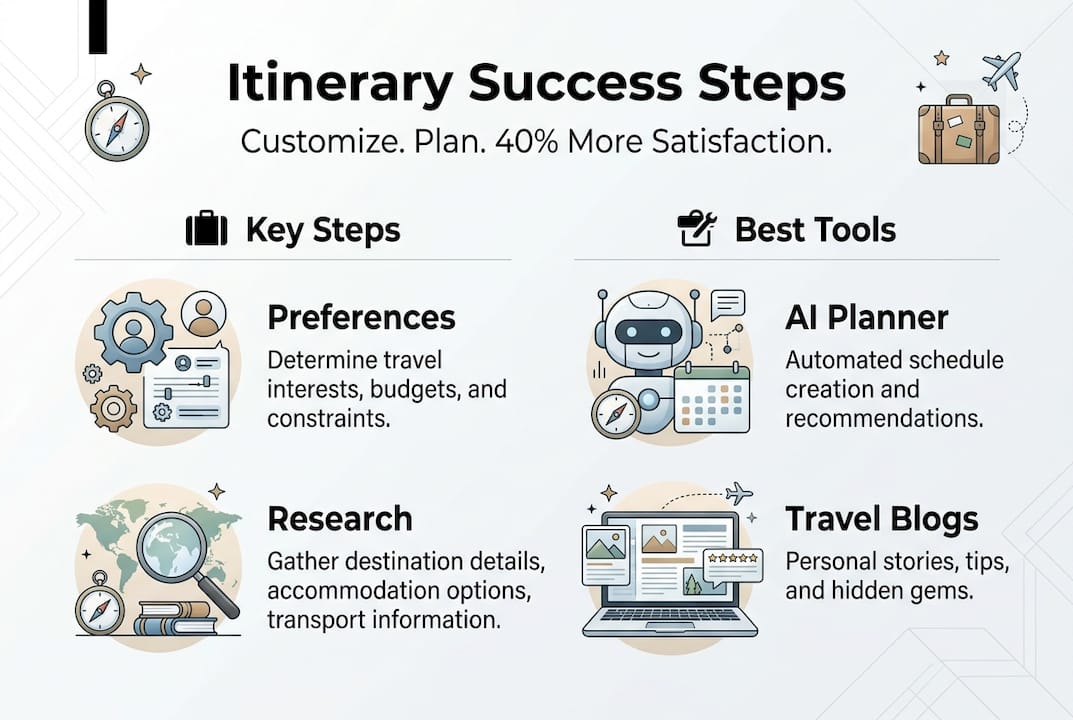
You book a package tour, arrive at the destination, and spend three days doing things you never actually wanted to do. Sound familiar? Most travelers have been there. Custom itineraries yield 40% higher satisfaction than standard package tours, and the gap keeps growing as travelers demand experiences that reflect who they actually are. This guide walks you through every stage of building a personalized travel plan, from choosing the right tools to verifying your route before you leave home.
Key Takeaways
Point
Details
Custom itineraries boost satisfaction
Personalized plans typically lead to more fulfilling and enjoyable travel experiences.
AI and manual planning complement
Combining technology and personal touch delivers the best outcomes when making travel plans.
Verify details before departure
Double-check routes and recommendations to ensure your itinerary is practical and flexible.
Market for customization is growing
Demand for personalized travel solutions is rising, making this skill increasingly valuable.
Why custom travel itineraries matter
Travel is personal. The idea that one pre-packaged tour can satisfy a solo foodie, a family of five, and a couple celebrating an anniversary is, frankly, absurd. Yet the travel industry has sold that idea for decades. The good news is that the shift is already happening.
The personalized travel market is forecasted to reach $317 billion by 2029, driven by travelers who want their trips to reflect their real interests, not a brochure. This is not a niche trend. It is a fundamental change in how people think about travel.
Here is what personalized planning actually delivers:
Experiences that match your pace. You decide how many museums, beaches, or restaurants fit into a day.
Budget control. You allocate money where it matters most to you.
Flexibility. A custom plan bends when reality does not cooperate.
Authenticity. You discover places that generic tours skip entirely.
Researchers studying AI trip planning advantages confirm that travelers who engage actively in their own planning report stronger emotional connections to their destinations. Building a solid vacation planning workflow is the foundation of all of this.
Core tools for itinerary creation
The right tool depends on your travel style, technical comfort, and how much time you want to invest. Here is a side-by-side look at the most popular options:
Tool
Best for
Speed
Depth
Cost
AI planners
Fast first drafts
Very fast
Moderate
Free to low
Google My Maps
Visual routing
Fast
Moderate
Free
Guidebooks
Deep local context
Slow
High
Low to moderate
Travel blogs
Hidden gems, local tips
Moderate
High
Free
Professional planners
Complex, multi-destination trips
Slow
Very high
High
Core tools for custom itineraries include AI-powered planners, Google My Maps, guidebooks, blogs, and professional planners, each serving a different planning need. The best travel apps can also consolidate bookings, maps, and notes in one place, which saves real time.
AI tools deserve special attention. They generate itinerary drafts in seconds, pulling from massive datasets of traveler reviews and destination information. However, LLMs struggle with disruptions and longer trip horizons, meaning they can miss real-time closures, seasonal changes, or nuanced local preferences. Tools like the Otto AI travel assistant are pushing the boundaries of what AI can do for travelers, but human judgment still plays a critical role.
Pro Tip: Always verify AI-suggested opening hours, prices, and transport connections independently. A quick search takes two minutes and can save hours of frustration on the ground.
Step-by-step process for building your itinerary
Building a custom itinerary is not complicated, but it does require a clear sequence. Skip steps and you end up with a plan that looks great on paper but falls apart on day two.
Define your preferences. Write down your non-negotiables: cuisine, activity type, pace, accessibility needs, and travel companions.
Research your destination. Use a mix of travel blogs, forums, and AI tools to build a long list of potential experiences.
Set your budget. Assign rough cost ranges to accommodation, transport, food, and activities before you commit to anything.
Map your routes. Use Google My Maps or a similar tool to visualize daily movement and spot inefficiencies.
Verify feasibility. Check opening days, booking requirements, and travel times between locations.
Build your day-by-day plan. Sequence activities logically, grouping nearby attractions to minimize transit time.
Hybrid approaches that combine AI speed with manual intent-setting consistently produce the strongest results. Here is a rough time estimate for each step:
Planning step
Average time needed
Define preferences
10 to 15 minutes
Destination research
30 to 60 minutes
Budget setting
15 to 20 minutes
Route mapping
20 to 30 minutes
Feasibility check
15 to 25 minutes
Day-by-day build
30 to 45 minutes
A solid travel checklist keeps you from missing critical details during this process. If you are traveling with others, use a shared document so everyone can contribute preferences and flag concerns early. Families especially benefit from a structured approach, and resources that help you plan family vacations can cut planning time significantly.
Pro Tip: Local travel blogs written by residents, not tourists, are gold mines for finding restaurants, viewpoints, and neighborhoods that never appear in mainstream guides.
Troubleshooting common planning mistakes
Even experienced travelers make planning errors. Knowing what to watch for saves you from the most common trip-ruining mistakes.
Here are the pitfalls that show up most often:
Over-relying on AI output. AI risks include hallucinations and outdated information. A museum listed as open may have closed months ago.
Ignoring weather patterns. Booking outdoor activities during monsoon season or a beach trip during a regional holiday crush is avoidable with basic research.
Missing transport connections. A 20-minute drive on a map can become a 90-minute ordeal without a car. Always check public transit options and schedules.
Packing too much into each day. Overscheduling is the number one reason travelers feel exhausted rather than refreshed.
Skipping local event calendars. Festivals, public holidays, and sporting events can close attractions or spike accommodation prices overnight.
“AI tools reduce disruption resolution time from 27 minutes to 4.3 minutes and lower traveler stress by 38%.” — MIT News
The solution is a hybrid strategy. Use AI vs manual planning as complementary approaches rather than competing ones. Let AI handle the first draft and route suggestions, then apply your own knowledge and research to refine the details. This combination preserves spontaneity while dramatically cutting planning time.
Verifying and refining your itinerary before you travel
A plan that has not been tested is just a wish list. Verification is what turns a good itinerary into a great trip.
Here is what to check before you finalize anything:
Route practicality. Walk through each day mentally. Does the sequence make geographic sense? Are you backtracking unnecessarily?
Transport connections. Confirm that buses, trains, or ferries run on the days you need them, especially in rural areas.
Booking requirements. Some attractions require advance reservations weeks or months out. Check this early.
Local feedback. Post your rough itinerary in a destination-specific travel forum or Facebook group. Locals and recent visitors will flag issues you missed.
Weather and seasonal updates. Check forecasts and seasonal closures within two weeks of departure.
LLMs and hybrid methods improve itinerary structure significantly, but human vetting remains essential for real-world feasibility. The best travel planning apps now include real-time alerts for closures, weather changes, and transport disruptions, which makes ongoing verification much easier.
Pro Tip: Build at least one unscheduled half-day into every three-day block. The best travel memories often come from the unexpected detour, the cafe you stumbled into, or the local market you found by accident.
Take your travel planning further with Around Travel
Building a custom itinerary is one of the most rewarding parts of travel planning, but it works best when you have the right support behind it. Around Travel brings together the tools, resources, and booking options you need to move from a great plan to a seamless trip.
Once your itinerary is set, getting around your destination is the next priority. Around Travel makes it easy to arrange car bookings for road trips and multi-stop adventures, or to book reliable taxi services for city transfers and airport runs. Whether you are planning a solo adventure, a family vacation, or a luxury escape, Around Travel has the resources to help you book, manage, and enjoy every part of your journey with confidence.
Frequently asked questions
What are the best digital tools for building a custom itinerary?
AI-powered planners, Google My Maps, guidebooks, and travel blogs are the top tools for creating a personalized travel plan, each offering different strengths depending on your planning style.
How much time does it take to create a custom travel itinerary?
Manual itinerary creation takes between 30 and 60 minutes for a basic trip, while AI tools can generate a first draft in minutes, though human review is still needed.
Are AI-generated travel plans reliable?
AI travel plans are fast and useful as starting points, but AI requires human vetting to catch outdated information, hallucinations, and feasibility gaps before you travel.
How do I avoid common mistakes when planning a custom itinerary?
Double-check AI suggestions against current sources, research local conditions and events, and get feedback from recent visitors to ensure your plan holds up in the real world.
Can personalized itineraries improve travel satisfaction?
Yes. Research shows custom itineraries yield 40% higher satisfaction compared to standard package tours, making the extra planning effort well worth it.
An avid traveler and seasoned writer who has journeyed across more than 40 countries, sharing his unique experiences and insights with a growing audience of adventure seekers and travel enthusiasts. With a passion for discovering hidden gems and immersing himself in diverse cultures, Jonas's travel blog combines practical tips, stunning photography, and captivating storytelling. Whether he's navigating bustling city streets or exploring remote landscapes, Jonas offers readers an authentic glimpse into the world's most fascinating destinations, inspiring them to embark on their own unforgettable journeys.
Providing You With Access To The Top Travel Destinations. Book Now and Enjoy!
TESTIMONIALS
Travelers Reviews
Planning a trip used to be a stressful event, until I found Around
Travel. The website made everything so easy and convenient and really has made
travelling a relaxing experience. I highly recommend using them.
Sam Wistan Marketing Consultant, USA
I travel a lot for business and making reservations used to take up so
much time. Around Travel offers me quick access to all my booking needs.
Jonas DuPont Investment Advisor, London
I am a spur of the moment type of girl and I like to book trips at a
whim. Around Travel always has great deals and options for me to choose from.