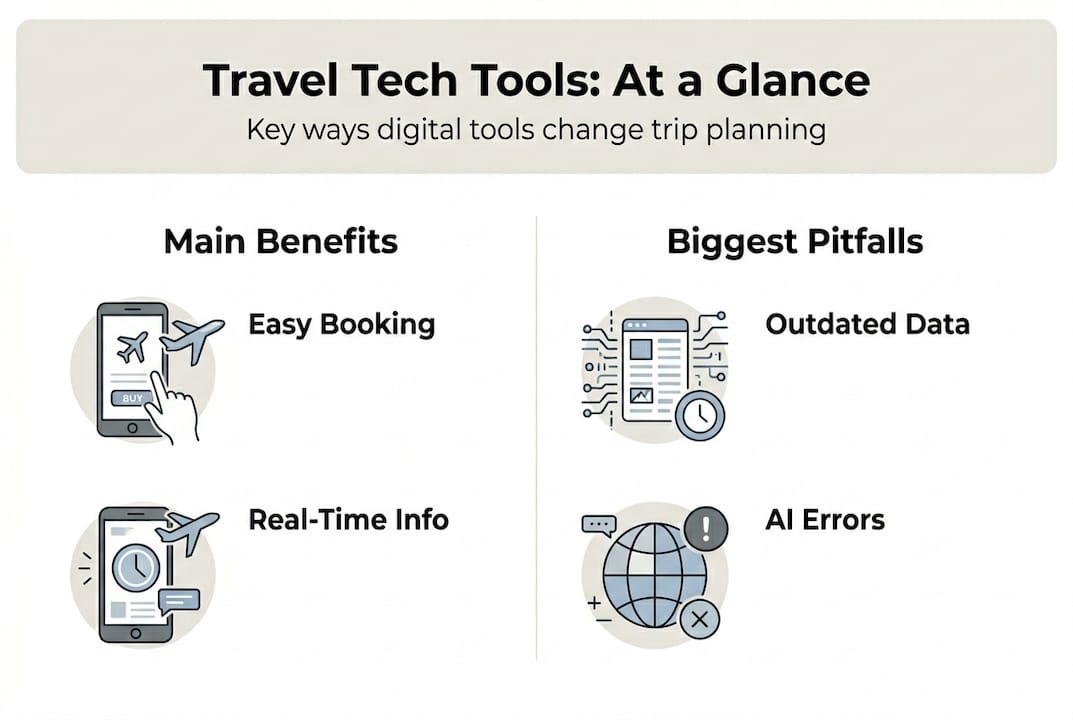
Technology has transformed travel planning from slow manual processes to instant digital solutions.
Travelers should verify AI-generated plans and data to avoid errors and outdated information.
Balancing digital tools with human judgment yields the best travel experiences.
Technology now influences nearly every decision a traveler makes, from the first search query to the final hotel check-in. Mobile apps, aggregators, and meta-search platforms simplify booking by providing real-time price comparisons, inventory availability, and bundled experiences. But the story isn’t entirely rosy. Alongside genuine convenience, digital tools introduce new risks: outdated data, AI-generated errors, and the false confidence that comes from trusting an algorithm too completely. This guide breaks down the real tools shaping modern travel, where they shine, where they stumble, and how you can use them strategically to plan trips that actually go the way you imagined.
Key Takeaways
Point
Details
Tech simplifies booking
Digital tools let travelers book flights, hotels, and experiences faster and compare more options than ever before.
AI isn’t infallible
Even advanced AI tools can make mistakes, so always double-check complex itineraries and details.
Personalization is rising
Tech increasingly tailors recommendations, but human judgment remains vital for the best trips.
Smart strategies win
Blending technology with a few verification habits and expert help yields the smoothest, most enjoyable travel.
From paper maps to AI: The evolution of travel planning
Not long ago, planning a trip meant visiting a travel agent, flipping through thick guidebooks, and folding paper maps that never quite refolded correctly. Booking a flight required a phone call. Confirming hotel availability meant waiting days for a fax. For families planning a summer vacation or adventure seekers mapping a backcountry route, the process was slow, expensive, and heavily dependent on whoever happened to be behind the agency desk.
The first major shift came with the internet. Online booking engines like Expedia and Hotels.com gave travelers direct access to inventory, cutting out the middleman and dramatically lowering prices through competition. Suddenly, you could compare dozens of hotels in minutes instead of days. That was revolutionary.
Then came the smartphone era. Mobile apps made it possible to book a flight from a taxi, check in remotely, and receive real-time gate change alerts. Mobile apps, aggregators, and meta-search platforms changed how travelers plan and oversee journeys, turning what was once a weeks-long research project into a few hours of tapping and swiping.
Here’s how the evolution unfolded in clear stages:
Pre-digital era: Travel agents, printed guidebooks, and paper maps dominated. Planning was personal but slow.
Early internet (late 1990s to early 2000s): Online booking platforms arrived, giving travelers direct access to prices and availability.
Mobile revolution (2010s): Smartphones enabled on-the-go booking, real-time alerts, and app-based itinerary management.
Aggregator and meta-search growth: Platforms began pulling data from multiple sources, letting travelers compare everything in one place.
AI and predictive planning (present): Machine learning now powers personalized recommendations, dynamic pricing alerts, and even automated itinerary building.
“The biggest shift isn’t just speed. It’s the transfer of control from intermediaries to travelers themselves. Technology handed the planning power directly to the person taking the trip.”
For families trying to coordinate school schedules, adventure seekers planning multi-country routes, or leisure travelers wanting custom travel itineraries, this evolution has been genuinely transformative. If you want a structured approach to building your own plan, the efficient travel itinerary guide offers a practical starting point that bridges digital tools with real-world logistics.
Top technologies shaping travel planning today
With this technological progression in mind, it’s time to explore which tools have become essential for the modern traveler.
Apps and aggregators offer real-time comparisons and experience bundling, making them the go-to starting point for most travelers. But each tool type has a distinct role, and knowing when to use which one is where most people get it wrong.
Tool type
Best for
Key limitation
Meta-search platforms
Price comparison across airlines and hotels
No direct booking support
Aggregator apps
Bundling flights, hotels, and car rentals
May miss niche or local options
AI travel assistants
Itinerary drafting and inspiration
High error rate in complex plans
Specialized apps
Specific needs (maps, translation, reviews)
Fragmented experience
Here’s when each tool type earns its place:
Use meta-search when you’re in the early research phase and want to scan price ranges before committing.
Use aggregators when you’re ready to book and want to bundle services for potential discounts.
Use AI assistants for brainstorming destination ideas or drafting a rough itinerary framework, not as a final source of truth.
Use specialized apps (like offline maps or translation tools) once you’re on the ground and need targeted support.
The caution around AI tools is worth taking seriously. GPT-4 achieves only a 0.6% pass rate on the TravelPlanner benchmark with real-world constraints, and 90% of AI-generated itineraries contain errors. That’s not a reason to avoid AI entirely. It’s a reason to treat it as a first draft, not a finished plan.
For a broader look at what’s available, the top travel apps guide covers the most reliable options by traveler type. If you’re curious about how AI is being applied in specific regional contexts, the story of AI travel assistants offers a fascinating real-world example.
Pro Tip: Don’t rely on a single tool. Start with a meta-search engine to anchor your price expectations, use an aggregator to bundle and book, then run your draft itinerary through an AI assistant for gap-spotting. Always verify the output manually before confirming anything.
The real impact: How technology personalizes and streamlines your trip
So, what are the concrete benefits and possible blind spots of using technology to plan your trip?
Data-driven recommendations have genuinely improved trip satisfaction for many travelers. Algorithms analyze your past searches, preferred price points, and travel dates to surface options you might never have found manually. For a family trying to balance budget, kid-friendly activities, and proximity to an airport, that kind of filtering is enormously useful.
The areas where technology delivers the most value include:
Destination discovery: Recommendation engines surface lesser-known destinations that match your interests.
Booking speed: What once took hours of phone calls now takes minutes.
Price tracking: Alerts notify you when fares drop, removing the need to obsessively refresh airline websites.
But the data also reveals a meaningful gap. Empirical benchmarks highlight a gap between feasible plans (which AI can generate at a reasonable rate) and truly optimal, preference-aligned ones (which remain rare). In plain terms: AI can get you a plan, but not necessarily your plan.
The debate is real. Proponents see AI enabling hyper-personalization and efficiency; critics note persistent errors and the irreplaceable human touch. Both sides have a point. The technology is impressive and genuinely useful, but it doesn’t yet understand why you’d rather have a slow morning in a quiet neighborhood than a packed schedule of tourist landmarks.
Real-world pitfalls include AI recommending attractions that have permanently closed, suggesting transit routes with impossible connection times, and misreading opening hours due to outdated training data. These aren’t edge cases. They’re common enough that every experienced traveler has a story.
For families managing complex logistics, the family vacation workflow offers a structured approach that layers technology over human judgment rather than replacing it. And if you want to understand where travel itself is heading, the 2026 travel trends piece provides useful context for how tech is reshaping traveler expectations.
Overcoming tech pitfalls: Smart strategies for reliable travel plans
To get the best from travel tech while avoiding headaches, keep these expert-backed strategies in mind.
Technology shifts travel planning from manual research to AI-orchestrated, dynamic experiences, but requires human verification for accuracy, especially in edge cases. That’s not a caveat. It’s the core operating principle for anyone who wants their trip to actually work.
Common tech pitfalls to watch for:
Stale data: AI models and even aggregators sometimes pull outdated pricing or availability.
Overconfidence in reviews: Aggregated ratings can mask recent declines in quality.
Missed local nuance: Algorithms don’t know that a particular neighborhood is noisy in August or that a popular restaurant is closed on Mondays.
Connectivity dependence: Relying entirely on apps without offline backups creates real vulnerability when you’re abroad.
Here’s a practical verification process you can follow for any trip:
Build your draft using an aggregator or AI tool to establish a baseline itinerary.
Cross-check key details directly with airlines, hotels, and tour operators via their official websites.
Verify opening hours and access for attractions through local tourism boards or recent traveler forums.
Check transit logistics using official transport authority apps, not just Google Maps estimates.
Build buffer time into every transition, especially for international connections or multi-modal journeys.
Save offline copies of all confirmations, maps, and contact numbers before you leave.
“The travelers who have the fewest problems abroad aren’t the ones who use the most technology. They’re the ones who know exactly when to stop trusting it.”
For complex trips, especially multi-destination itineraries, group travel, or adventure routes with logistical dependencies, the value of expert travel agent advice is hard to overstate. A good agent knows the gaps that algorithms miss.
Pro Tip: Keep a simple paper backup of your first night’s accommodation address, emergency contacts, and confirmation numbers. If your phone dies or gets stolen on arrival, that single sheet of paper is worth more than every app you downloaded.
Our take: Where travel tech excels and where travelers should stay cautious
Conventional wisdom says technology has made travel agents obsolete and that anyone with a smartphone can plan a flawless trip. We’d push back on that, hard.
Technology is exceptional at the mechanical parts of travel planning: finding prices, comparing options, tracking availability, and sending reminders. It’s genuinely bad at the human parts: understanding what you actually want from a trip, reading between the lines of a destination’s culture, or knowing that a particular hotel’s five-star rating doesn’t reflect the construction noise outside.
The travelers who get the most out of digital tools are the ones who treat them as a starting point, not a final answer. They use apps to generate options, then apply judgment to filter them. They trust algorithms for logistics and trust their own instincts for experience. That balance is what separates a good trip from a great one.
Exploring the value of authentic travel is a reminder that the best moments rarely come from an algorithm. Tech-augmented judgment, not tech replacement, is the sweet spot every traveler should aim for.
Plan smarter trips with Around Travel
If you’re ready to experience more from your next trip, take advantage of what Around Travel offers.
Around Travel’s planning platform brings together the best of digital convenience and personalized support in one place. Whether you’re booking a family getaway, a solo adventure, or a luxury escape, you’ll find hotels, flights, tours, and rental car options all in one streamlined experience. The platform is built for travelers who want real choices, not just algorithmic defaults. Browse curated destination guides, compare trusted booking options, and get the kind of organized, reliable travel experience that technology alone rarely delivers. Start planning your next trip today.
Frequently asked questions
How do meta-search platforms improve travel booking?
Meta-search platforms let you compare prices and options in real time across multiple providers, helping you identify the best deals without visiting dozens of individual booking sites.
Can AI reliably plan a family or adventure trip?
AI tools provide useful starting points for itinerary ideas, but 90% of AI-generated itineraries contain errors, so always verify details before booking anything.
What’s the biggest benefit of using technology for travel planning?
Apps and aggregators centralize research, booking, and reviews in one place, saving significant time and making it easier to compare and organize every step of your trip.
How can I avoid mistakes when using travel apps or AI tools?
Cross-check all bookings and time-sensitive details directly with providers, and for complex itineraries, human verification from a travel expert adds a layer of accuracy that no app currently matches.
An avid traveler and seasoned writer who has journeyed across more than 40 countries, sharing his unique experiences and insights with a growing audience of adventure seekers and travel enthusiasts. With a passion for discovering hidden gems and immersing himself in diverse cultures, Jonas's travel blog combines practical tips, stunning photography, and captivating storytelling. Whether he's navigating bustling city streets or exploring remote landscapes, Jonas offers readers an authentic glimpse into the world's most fascinating destinations, inspiring them to embark on their own unforgettable journeys.
Providing You With Access To The Top Travel Destinations. Book Now and Enjoy!
TESTIMONIALS
Travelers Reviews
Planning a trip used to be a stressful event, until I found Around
Travel. The website made everything so easy and convenient and really has made
travelling a relaxing experience. I highly recommend using them.
Sam Wistan Marketing Consultant, USA
I travel a lot for business and making reservations used to take up so
much time. Around Travel offers me quick access to all my booking needs.
Jonas DuPont Investment Advisor, London
I am a spur of the moment type of girl and I like to book trips at a
whim. Around Travel always has great deals and options for me to choose from.