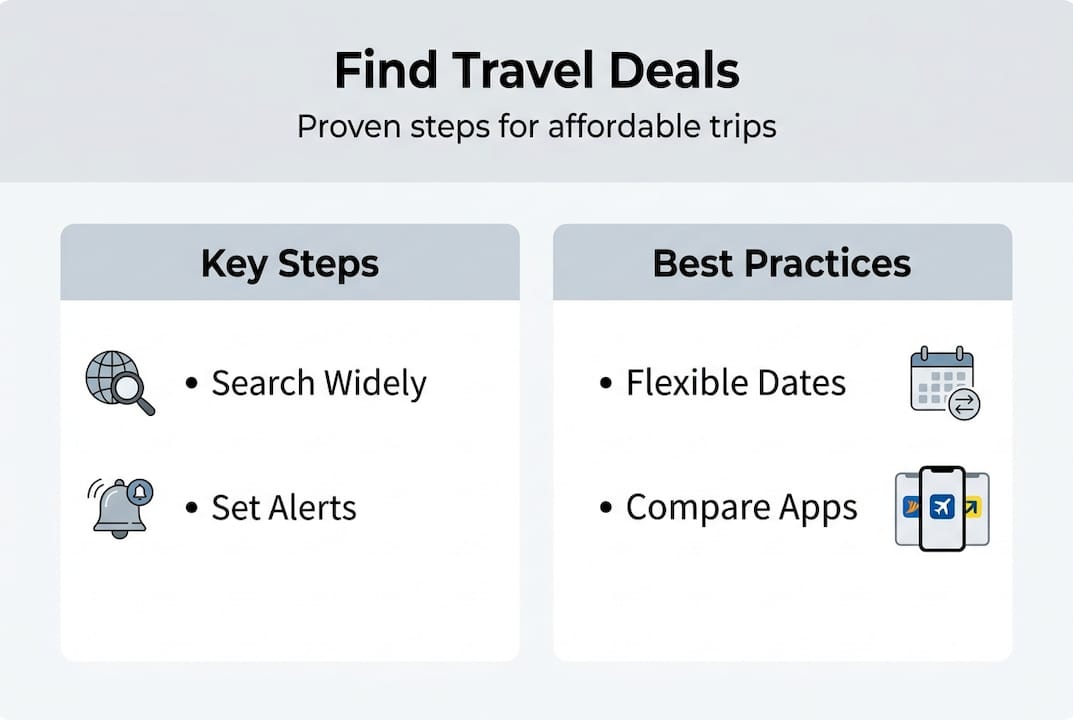
Flexible planning and using price alerts can significantly reduce travel costs.
Comparing accommodation options and booking during shoulder seasons saves money.
Acting quickly on deals and prioritizing price over convenience boost savings.
Travel costs stop more people from seeing the world than they should. High travel costs deter millions from exploring new destinations every year, yet proven methods exist to make almost any trip affordable. The gap between an expensive vacation and a budget-friendly one often comes down to timing, tools, and a willingness to stay flexible. This guide walks you through exactly how to score deals on flights, accommodations, and activities using research-backed strategies that work in 2026. No gimmicks, no vague advice, just steps you can act on today.
Key Takeaways
Point
Details
Flexibility cuts costs
Being open with dates, airports, and destinations leads to the lowest travel prices.
Compare before booking
Check multiple sites and direct deals to find the best rates for flights and lodging.
Leverage bundles and passes
Combining flights, hotels, or activities can save hundreds while still giving a rich experience.
Use alerts and tools
Flight and hotel search engines and price alerts help catch savings before prices shift.
Flight deals: When, where, and how to book
Flights are usually the biggest variable in any travel budget. A fare for the same route can swing by hundreds of dollars depending on when you search, how you search, and how flexible you are. Mastering this one category can transform your entire travel budget.
The most powerful move you can make is building flexibility into your plans. Flexible travel planning consistently produces lower fares because algorithms reward travelers who are not locked into a single date or airport. Tools like Google Flights’ Explore map and Skyscanner’s “Everywhere” search show you the cheapest destinations from your home city on any given date. That single shift in mindset, letting prices guide your destination rather than the other way around, is where serious savings begin.
Top flight search tools to use in 2026:
Google Flights for price calendars and fare tracking
Skyscanner for multi-destination and flexible date searches
Kayak for combined alerts across airlines
Going (formerly Scott’s Cheap Flights) for mistake fares and deal alerts
Hopper for fare prediction and price freezing
Setting price alerts on at least two of these tools means you get notified the moment a route drops, rather than checking manually every day.
Route type
Best booking window
Cheapest travel days
Domestic
1 to 3 months out
Tuesday, Wednesday
International
2 to 8 months out
Tuesday, Wednesday
Last-minute domestic
Under 2 weeks
Varies by route
Pro Tip: Book mid-week flights whenever possible. Tuesday and Wednesday departures are consistently among the lowest-priced options, and avoiding Friday and Sunday travel can save 15 to 20 percent on popular routes.
One of the biggest myths in budget travel is that Tuesday is always the cheapest day to buy a ticket. No single cheapest day exists for booking; flexibility beats rigid rules every time. Airlines adjust pricing dynamically, so a Tuesday search might yield a great fare one week and nothing special the next.
“Using search engines, setting price alerts, and being flexible are the three pillars of lower airfare.” This framework from Expedia’s 2026 Air Hacks report reflects what data consistently shows across millions of bookings.
For efficient trip planning, always search with a plus or minus three-day window around your target dates. That small adjustment regularly surfaces fares 20 to 40 percent below the locked-in date price.
Mastering the art of affordable accommodations
Once you’ve secured cheap flights, accommodations become the next biggest savings opportunity. Most travelers default to one booking platform, which is a costly habit. Rates for the same room vary significantly across Booking.com, Hotels.com, Expedia, and the hotel’s own website. Comparing all four takes five extra minutes and can save you $30 to $80 per night.
Booking directly with the hotel is underrated. Many properties offer price-match guarantees or throw in extras like free breakfast or late checkout when you bypass the third-party platforms. It is always worth a quick call or email to ask.
Strategies that consistently lower accommodation costs:
Book mid-week stays (Sunday through Thursday) for lower rates at city hotels
Travel in the shoulder season to avoid peak pricing surges
Stay outside city centers and use public transit to save 30 to 50 percent on nightly rates
Consider motels, private Airbnb rooms, or budget hostels in Bangkok and other popular destinations for genuine value
Bundle flights and hotels together on Expedia or Booking.com for package discounts
Accommodation type
Average nightly cost
Best for
Budget hostel (shared dorm)
$15 to $35
Solo travelers, backpackers
Hostel private room
$40 to $75
Couples, social travelers
Motel or budget hotel
$55 to $110
Road trips, short stays
Mid-range hotel
$100 to $180
Comfort seekers
Airbnb private room
$45 to $120
Longer stays, local feel
Pro Tip: Book a refundable rate first, then recheck prices two to three weeks before your stay. If the price has dropped, rebook at the lower rate and cancel the original. This habit alone saves frequent travelers hundreds of dollars annually, according to accommodation savings research.
Loyalty programs are another underused tool. Signing up for free hotel loyalty accounts at Marriott, Hilton, or IHG costs nothing and earns points toward free nights. Even if you only stay at a brand twice a year, the points accumulate faster than most people expect. Comparison shopping, shoulder season booking, and loyalty programs remain the three most reliable drivers of hotel savings in 2026.
A practical example: a solo traveler spending four nights in a European city center hotel at $150 per night pays $600. Moving to a well-reviewed design hostel just one metro stop away at $55 per night cuts that to $220. Same city, same experience, $380 saved.
Finding deals on activities, attractions, and experiences
With transport and lodging sorted, maximizing experiences comes next, but it doesn’t have to drain your budget. Activities and attractions are often where travelers overspend simply because they don’t know cheaper options exist.
City passes are one of the smartest investments for urban itineraries. City passes save up to 42% on top attractions by bundling entry fees into a single discounted pass. New York, Chicago, San Francisco, and dozens of international cities offer them. If you plan to visit three or more major attractions in a city, the math almost always favors the pass.
High-value, low-cost activity strategies:
Book free walking tours (tip-based) for local context and hidden neighborhood gems
Check museum free days, which most major museums offer weekly or monthly
Use combo tickets that pair two or three attractions at reduced rates
Download local discount apps like Groupon, Fever, or city-specific tourism apps
Prioritize free natural attractions: parks, waterfronts, public markets, and street art districts
The best experiences in most cities are free. Locals rarely pay to stand in line at tourist traps. Follow their lead and your trip gets richer and cheaper at the same time.
For families or groups, the savings from passes and combo tickets multiply fast. A family of four visiting three paid attractions individually might spend $300. The same itinerary via a city pass typically runs $175. That’s $125 back in your pocket for food or an extra day of exploring. Building your trip around custom travel itineraries helps you identify where passes add real value versus where free alternatives are just as good. For broader inspiration on keeping costs down across your whole trip, cheap travel strategies offer additional angles worth reviewing.
Advanced strategies: Last-minute, hidden deals, and expert hacks
If you’re ready for the next level, a few advanced techniques can push your budget further, but they require caution and a flexible mindset.
Last-minute hotel apps like HotelTonight regularly list unsold rooms at 40 to 50 percent off standard rates. This works best in larger cities with high hotel density. For flights, last-minute deals are riskier. Airlines do occasionally release unsold seats cheaply within 48 hours, but it is not reliable enough to plan around unless you are genuinely schedule-free.
Advanced tactics worth knowing:
Use a VPN set to a country with lower purchasing power to check if flight prices differ by region
Pay in the local currency of the airline’s home country to avoid foreign transaction markups
Search hidden-city tickets (booking a flight through your destination as a layover) cautiously; airlines can and do penalize frequent use of this tactic
Look for senior, military, student, and government employee discounts that are not always advertised on the main booking page
Pro Tip: Split ticketing, booking two separate one-way tickets instead of a round trip, can occasionally save money on budget carriers. Always check baggage fees separately, though. A $30 ticket saving can vanish if the split routing adds checked bag costs on both legs.
Know when convenience beats savings. Spending two hours engineering a $15 discount is rarely worth it. Focus your effort on the big three: flight timing, accommodation comparison, and activity passes. That’s where the real money lives.
For additional guidance on senior and frequent traveler discounts, expert flight tips from AARP cover specific programs that many travelers never discover.
The truth most travel deal guides miss
Here’s something worth saying directly: most deal-hunting guides focus on tactics when the real leverage is behavioral. Obsessing over whether to book on a Tuesday versus a Wednesday, or debating which VPN location gives the cheapest fare, is a distraction from the single biggest factor in getting a great deal: how quickly and decisively you act when a real deal appears.
We’ve watched travelers miss $350 transatlantic fares because they spent three days “thinking about it.” By then, the price had doubled. The best deals don’t wait. Prioritizing flexibility means being ready to say yes fast, not just knowing the right search tools.
One traveler we know changed her destination entirely when Paris fares spiked the week she planned to book. She shifted to Lisbon on a whim after seeing a fare 40 percent lower. She had one of her best trips ever and paid less than her original budget. That is what real flexibility looks like: letting prices inform decisions rather than just influence them.
The travelers who consistently find great deals start with the broadest possible search and only narrow down once price patterns are clear. They are not hunting for one perfect trip; they are shopping for the best value available in their target window. That shift in framing changes everything.
Unlock bigger savings with Around Travel
You now have a solid framework for finding deals across every part of your trip. The next step is having a reliable platform to put it all together.
Around Travel brings flights, hotels, tours, and affordable car rentals into one place so you can compare and book without jumping between a dozen tabs. Our curated deals are updated regularly to reflect real pricing, not inflated “original” rates designed to make discounts look bigger than they are. Whether you’re planning a weekend escape or a multi-week adventure, visiting Around Travel gives you a single hub for all the resources and bookings your itinerary needs. Come back often because new deals and destination guides go live every week.
Frequently asked questions
When is the best time to book flights for maximum savings?
Book domestic flights 1 to 3 months in advance and international flights 2 to 8 months out, with mid-week departures typically offering the lowest fares.
Are last-minute travel deals worth it?
They can be, especially for accommodations where last-minute hotel apps offer 40 to 50 percent off, but last-minute flights carry more risk and are not reliable for planned trips.
How can I check if a bundled travel deal really saves money?
Price the flight and hotel separately, then compare that total to the bundle; bundles typically save $100 to $300 depending on destination and travel dates.
Is traveling light actually cheaper?
Yes, packing carry-on only lets you avoid checked baggage fees that can add $35 to $75 per leg, and sometimes unlocks access to lower basic economy fares.
An avid traveler and seasoned writer who has journeyed across more than 40 countries, sharing his unique experiences and insights with a growing audience of adventure seekers and travel enthusiasts. With a passion for discovering hidden gems and immersing himself in diverse cultures, Jonas's travel blog combines practical tips, stunning photography, and captivating storytelling. Whether he's navigating bustling city streets or exploring remote landscapes, Jonas offers readers an authentic glimpse into the world's most fascinating destinations, inspiring them to embark on their own unforgettable journeys.
Providing You With Access To The Top Travel Destinations. Book Now and Enjoy!
TESTIMONIALS
Travelers Reviews
Planning a trip used to be a stressful event, until I found Around
Travel. The website made everything so easy and convenient and really has made
travelling a relaxing experience. I highly recommend using them.
Sam Wistan Marketing Consultant, USA
I travel a lot for business and making reservations used to take up so
much time. Around Travel offers me quick access to all my booking needs.
Jonas DuPont Investment Advisor, London
I am a spur of the moment type of girl and I like to book trips at a
whim. Around Travel always has great deals and options for me to choose from.