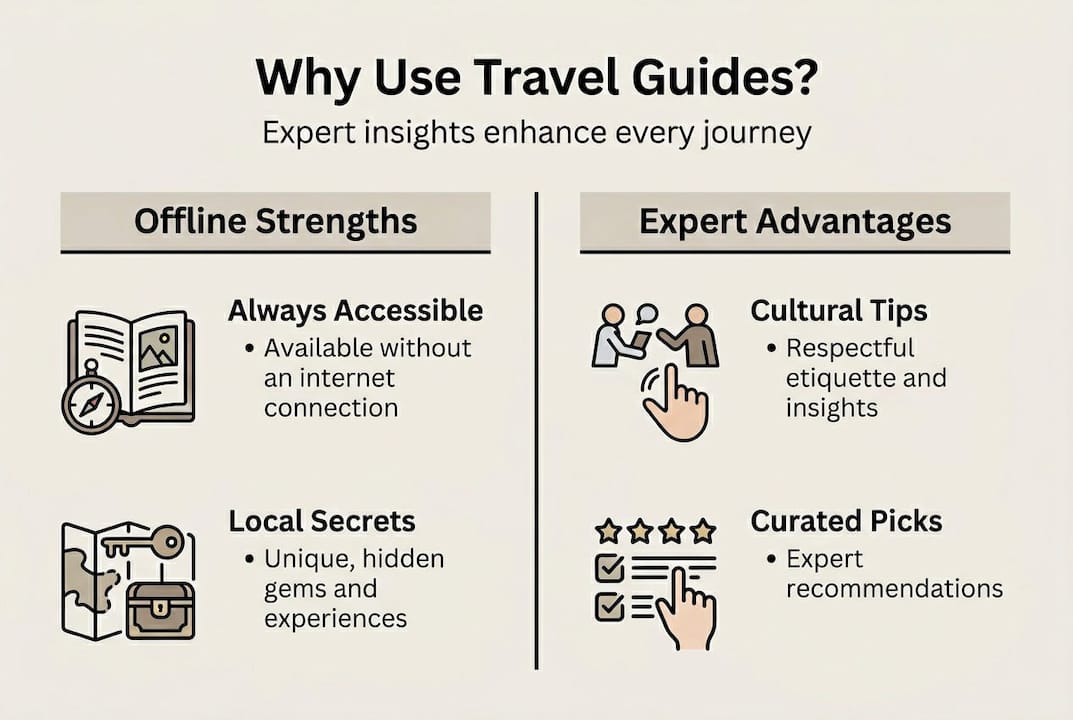
Travel guides provide reliable offline access and durability in remote or harsh environments.
Experts offer cultural nuances and local insights that search engines often miss.
Combining guides with digital tools enhances trip planning, exploration, and spontaneity.
Travel apps have changed how we explore the world, but they haven’t replaced everything. A good travel guide still does things that no algorithm can fully replicate, from navigating areas with zero connectivity to explaining why you should never hand someone money with your left hand in parts of the Middle East. Guidebooks offer offline reliability, no battery concerns, and durability in conditions that would destroy a smartphone screen. If you’ve ever watched your phone die in the middle of a foreign city with no charger in sight, you already understand the core argument here. This article covers what travel guides genuinely do better and how to use them strategically.
Key Takeaways
Point
Details
Offline reliability
Travel guides work anywhere, making them essential for remote or tech-limited trips.
Expert insights
Guides provide cultural context, etiquette, and tips that search engines can’t replicate.
Planning support
A good guide helps organize and customize your trip, reducing preparation stress.
Enhanced exploration
Guides direct you to unique spots and local experiences you might otherwise miss.
Reliability when and where you need it
Let’s say you’re hiking through a remote stretch of Patagonia, or navigating a rural village in Myanmar where the nearest cell tower is 40 miles away. Your offline map app cached the wrong region. Your battery is at 6%. Now what? This is where travel guides earn their keep in a way no tech product has fully solved.
Guidebooks offer offline reliability, no battery worries, and a physical durability that smartphones simply don’t have. Drop a guidebook in the rain and shake it off. Drop your phone in a puddle and your whole trip could unravel. That’s not a small distinction for travelers who venture off the main tourist path.
Here’s a quick comparison of how guidebooks and travel apps hold up in different environments:
Travel environment
Guidebook
Travel app
Remote areas with no signal
Works perfectly
Often fails
Low battery situations
Unaffected
Unusable
Extreme weather conditions
Durable (water-resistant covers)
Vulnerable
Densely urban areas
Works well
Ideal
First-time international trip
Strong planning anchor
Good for real-time updates
The pattern is clear. Apps shine in cities with strong infrastructure. Guides shine everywhere else, including the places that tend to be the most rewarding to visit.
When it comes to remote travel benefits, the safety net of a physical guide isn’t just convenient, it can be genuinely critical. Travelers in areas with unreliable connectivity often report that their guidebook was the single most important item in their pack.
Here are some key reliability advantages that guidebooks bring:
No dependence on Wi-Fi, mobile data, or roaming plans
Pages stay readable in direct sunlight, unlike phone screens
Physical guides don’t crash or require software updates mid-trip
They double as conversation starters with locals
Margin notes and bookmarks let you customize your copy over time
Pro Tip: Before any trip, scan or photograph the most critical pages of your guidebook and save them to your phone’s photo roll. That way you get the best of both worlds, offline digital access and a physical backup when the phone gives out.
For trips with a packed schedule, pairing a guidebook with solid itinerary planning tools creates a safety net that neither approach provides alone.
Expert insights, depth, and cultural nuances
Here’s the thing about search engines: they index information, but they don’t understand context. A Google search can tell you that tipping is common in the United States, but it won’t tell you that in Japan, tipping can actually be considered rude, and pressing money into someone’s hands might cause genuine discomfort. That’s the kind of nuance that a well-researched travel guide gets right.
Human researchers and writers who have spent months in a destination bring context that no algorithm can replicate. They know which neighborhoods feel sketchy after dark, which restaurants are beloved by locals versus tourist-priced and mediocre, and how to behave respectfully at a religious site. Remote areas lack connectivity and experts nuance cultural etiquette and bargaining tips that search results consistently miss.
“The best travel writing doesn’t just tell you where to go. It tells you how to be somewhere, with awareness, respect, and genuine curiosity.”
This depth matters more than most travelers realize until they make an avoidable mistake. Getting cultural norms wrong can result in anything from mild embarrassment to being denied entry to a sacred space. Good guides prevent those moments.
Here are examples of cultural nuances you’re far more likely to find in expert guides than in an app:
Bargaining etiquette in markets across Southeast Asia, including when to walk away
Dress codes for religious sites in Southern Europe and the Middle East, down to ankle versus knee coverage
Greeting customs like cheek kisses, bows, or avoiding eye contact in specific contexts
Food taboos that matter in certain religious communities or regions
Photography rules at temples, ceremonies, or around indigenous communities
For travelers who want expert travel guidance, a well-written guidebook functions as a trusted advisor in your backpack, one that was written by someone who actually made the journey.
Pro Tip: When preparing for a destination with complex cultural norms, look for guidebooks written by authors who lived in the region, not just visited. The difference in depth is significant and usually obvious by the third page.
This kind of specialist knowledge also fuels travel inspiration, helping you see a destination through a richer lens before you even arrive.
Planning made easier: Organize, customize, and reduce stress
Most trip planning stress comes from information overload. You’ve got forty browser tabs open, three forum threads running, and a notes app full of half-formed ideas. A good travel guide cuts through that noise by organizing destinations, logistics, and experiences into a coherent structure you can actually use.
Guidebooks supplement forums and online info, making trip planning more efficient rather than adding to the chaos. They give you a starting framework, which is exactly what most travelers need before they can start making smart decisions.
Here’s how a guide simplifies itinerary creation step by step:
Start with the destination overview to understand geography, climate, and key regions
Use the suggested itineraries as a starting skeleton, then customize based on your interests
Identify must-see versus skip-worthy based on honest, author-reviewed opinions
Note practical logistics including transit options, entry requirements, and local costs
Build your daily schedule by clustering nearby attractions to minimize travel time
Flag backup options for weather days or when a site is unexpectedly closed
Compare the main planning approaches to see where guides fit:
Planning method
Time required
Depth of insight
Reliability
Customization
Travel guidebook
Medium
High
Very high
High
DIY online research
High
Variable
Variable
Very high
Travel app
Low
Medium
Medium
Medium
Combination approach
Medium
Very high
Very high
Very high
The combination row tells the real story. Neither guides nor apps alone produce the best results. Together, they make a powerful planning system.
For travelers who want a structured starting point, a custom itinerary guide can help you build a personalized trip framework that matches your travel style. Pairing that with top planning apps gives you both the depth of a guide and the real-time flexibility of digital tools.
Enhancing exploration and the travel experience
Once you’re on the ground, travel guides shift from planning tools to discovery engines. This is where they genuinely change your day-to-day experience, often in ways you didn’t anticipate.
Apps tend to surface the same popular spots because their rankings are based on volume of reviews. A guidebook written by someone with deep regional knowledge will often point you toward the courtyard restaurant with no English menu, the unmarked trail that leads to a waterfall seen by fewer than fifty tourists a year, or the Wednesday market that locals actually use. These are the moments that define a trip, and they rarely appear in search results.
Guidebooks supplement forums and paper survives the elements, making them reliable companions even when you’re exploring rough terrain or unpredictable weather.
For solo travelers especially, a guide provides a kind of quiet confidence. Knowing you have a trusted resource in your bag, one that was vetted by a human who cared about getting it right, reduces anxiety in unfamiliar places. That mental clarity lets you be more present and spontaneous, which is ironic given that guides are often seen as rigid tools.
Here’s what a quality travel guide consistently delivers that apps often miss:
Hidden neighborhoods with authentic food scenes not yet on the tourist circuit
Seasonal timing tips for festivals, migrations, or weather windows
Safety context for specific streets, transit routes, or activities
Local language phrases written phonetically for genuine communication
Budget breakdowns with realistic cost expectations, not crowdsourced averages
Using a travel planning checklist alongside your guide helps ensure you haven’t skipped any logistics while leaving room for the unexpected discoveries. For inspiration on how guides can shape a complete regional journey, check out our Salzburger Land guide as a real example of layered, curated travel content.
Why the right travel guide can be your secret advantage
Here’s a perspective most travel content won’t share: the travelers who get the most out of any destination are rarely the best resourced. They’re the best prepared. And preparation isn’t about having every app installed. It’s about having the right kind of knowledge before you need it.
We’ve seen too many experienced travelers dismiss physical guides as outdated, only to regret it when their phone dies in a rural area or they inadvertently offend a host family because nobody told them about a local custom. A guide isn’t a crutch. It’s a curated body of knowledge assembled by someone who made the mistakes so you don’t have to.
The real secret is that guides enhance spontaneity rather than restrict it. When you know where you’re going and understand the cultural landscape, you can afford to wander. You feel safer saying yes to an invitation from a local because you already understand the context.
Dismissing all guides as relics misses how much they’ve evolved. Many now pair QR codes with printed content, bridging the analog and digital gap in smart ways. Exploring remote destination perspectives with a guide in hand often produces the most memorable travel stories. Don’t underestimate that.
Plan smarter with Around Travel’s resources
Travel guides give you the foundation. The right platform gives you everything else.
Around Travel brings together destination guides, curated travel tips, flight and hotel booking tools, and personalized recommendations all in one place. Whether you’re mapping out a multi-country itinerary or just trying to figure out the best base for a weekend escape, Around Travel’s resources make the research faster and the decisions clearer. You can even browse rental cars for seamless ground transportation once you arrive, so every leg of your trip is covered. From first idea to final booking, Around Travel is built to support the full journey.
Frequently asked questions
What can I find in a travel guide that travel apps don’t provide?
Travel guides offer in-depth local knowledge, cultural etiquette tips, and reliable offline access that most apps simply can’t match, especially in remote or low-connectivity areas.
Are travel guides still useful if I prefer using digital tools?
Absolutely. Physical guides are ideal backups for battery loss or no signal, and combining both ensures you have full coverage in every environment, as offline reliability remains a real advantage in many destinations.
Do travel guides help with cultural etiquette or local tips?
Expert-authored guides routinely include cultural insights, etiquette guidance, and hidden tips that search algorithms miss, making them especially valuable in destinations with complex social customs.
How can I use travel guides to build a better itinerary?
Step-by-step trip structures built into guides help you organize, customize, and streamline your plans, with planning made more efficient when guides supplement your online research rather than replace it.
An avid traveler and seasoned writer who has journeyed across more than 40 countries, sharing his unique experiences and insights with a growing audience of adventure seekers and travel enthusiasts. With a passion for discovering hidden gems and immersing himself in diverse cultures, Jonas's travel blog combines practical tips, stunning photography, and captivating storytelling. Whether he's navigating bustling city streets or exploring remote landscapes, Jonas offers readers an authentic glimpse into the world's most fascinating destinations, inspiring them to embark on their own unforgettable journeys.
Providing You With Access To The Top Travel Destinations. Book Now and Enjoy!
TESTIMONIALS
Travelers Reviews
Planning a trip used to be a stressful event, until I found Around
Travel. The website made everything so easy and convenient and really has made
travelling a relaxing experience. I highly recommend using them.
Sam Wistan Marketing Consultant, USA
I travel a lot for business and making reservations used to take up so
much time. Around Travel offers me quick access to all my booking needs.
Jonas DuPont Investment Advisor, London
I am a spur of the moment type of girl and I like to book trips at a
whim. Around Travel always has great deals and options for me to choose from.